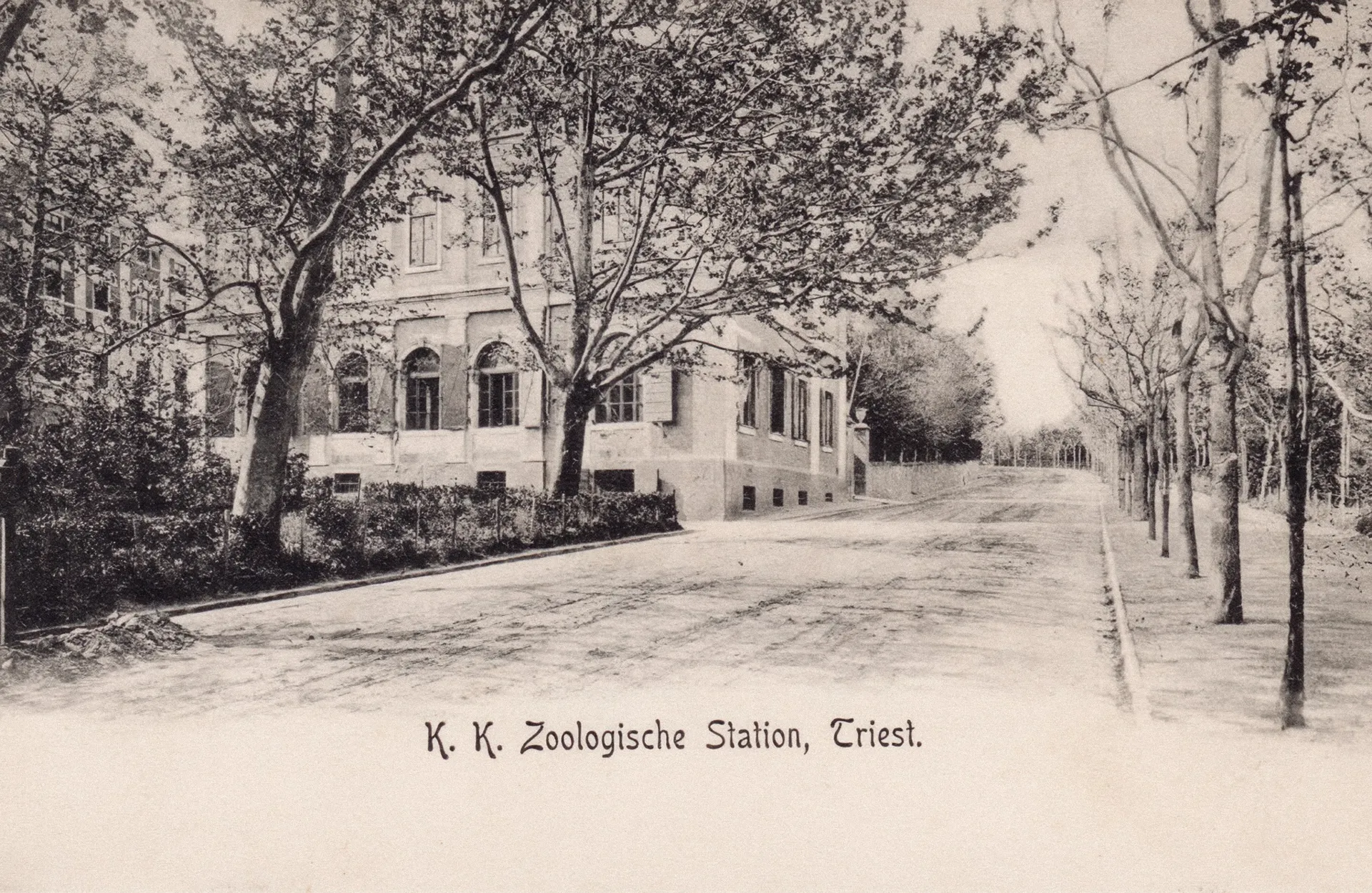
The k.k. Zoologische Station in Triest (Stazione Zoologica Imperiale e Reale di Trieste) was founded in 1875 in the context of the Austro-Hungarian Empire and represented one of the first and most important marine biological stations of the Adriatic and the Mediterranean. It was part of a network of scientific stations that arose within the ambit of the Habsburg area, with a specific vocation for the study of marine biology.
Role in the Habsburg Period
During the Habsburg period, the station was a cutting-edge research center, dedicated to the study of marine organisms and coastal ecosystems. Thanks to its strategic position in the port of Trieste, it promoted:
- International scientific collaborations;
- Close interaction with local fishermen, essential for the collection of samples.
The role of the station was part of a broader system of scientific institutes that characterized the Empire, with important attention to natural disciplines, in particular zoology and marine ecology.
Architectural and Scientific Aspects
From an architectural point of view, the headquarters was designed to ensure functional environments for biological research, such as:
- Laboratories;
- Tanks for the acclimatization of marine animals.
This infrastructure facilitated observation and study in conditions as close as possible to the natural habitat, reflecting an innovative scientific approach for the era. It was based on the creation of a marine "microcosm" capable of simulating natural environments, requiring complex technical knowledge and continuous interaction with the surrounding marine territory.
Post-War Transformations
In the first post-war period and with the dissolution of the Austro-Hungarian Empire, the station underwent important transformations, both due to the changed political context and the different scientific and cultural needs of the new Italian administration. Despite some difficulties, it remained a reference point for local biological research, although with a reduced role and importance compared to the past.
Historical and International Significance
The history of the k.k. Zoologische Station of Trieste thus reflects not only the evolution of marine biology as a discipline, but also the political, social, and cultural transformations that affected Trieste between the end of the nineteenth century and the beginning of the twentieth century. It testifies to the importance of the city as an international hub for scientific and cultural exchange in the Central European and Mediterranean area.
The station was part of an international scientific orbit, together with other prestigious biological stations such as that of Naples founded in 1872, entering into the debate on the need for experimental environments that faithfully reproduced natural conditions for the study of marine organisms.