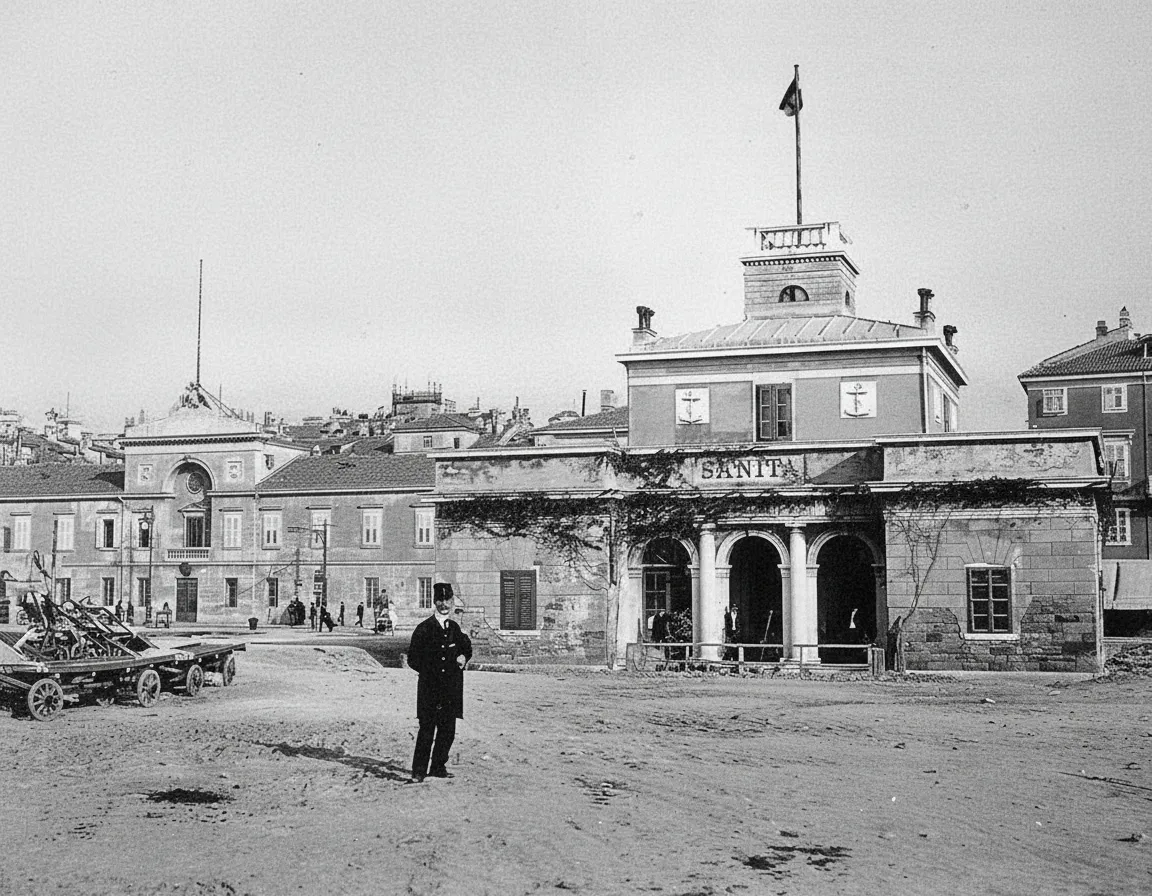
The Molo della Sanità — today molo dei Bersaglieri — is one of the historic piers of Trieste's Rive, located in front of the Borgo Giuseppino, south of Piazza dell'Unità d'Italia. Its history spans more than two centuries of port life, from the crumbling eighteenth-century landings to the monumental Maritime Station, up to today's terminal for large cruise ships.
Origins: the molo della Porporella
The origins of the pier date back to the eighteenth century, when this area held a modest cluster of ruined quays that the historian Edoardo Generini calls the "molo della Porporella", a term used throughout the peninsula to designate old ruined piers. A small pier of this kind existed until 1798 at the head of today's via Boccardi (then via Porporella); covered by the advancing shoreline, it was replaced in 1850 by a new pier.
The Casino della Sanità and the pier's name
During the nineteenth century the structure was progressively extended in length and width. From 1872 it was occupied by the Casino della Sanità, the maritime health office responsible for the sanitary inspection of ships, crews and passengers arriving in the port — a function that in Trieste formed part of the contagion-prevention system built around the city's lazarettos. From this presence derived the name Molo della Sanità, made official in 1909 on the occasion of a further enlargement. The English consul Sir Richard Francis Burton, in the city in the 1870s, described it as "the shortest of the moles; it faces the quarters of the Maritime Government and the pilots' office, and is completely occupied by the Casino della Sanità".
The wine warehouses and Zaninovich's customs hall
In the early twentieth century the pier housed, besides the Casino della Sanità, warehouses 41 and 42, used in the Habsburg era to store wines imported from the Kingdom of Italy. The Casino was later replaced by the Espositura Doganale — the "Dogana Vecchia" — a Secessionist-style work by the Dalmatian architect Giorgio Zaninovich, used for checking arriving and departing passengers: a single-storey building with a wide portico, long narrow windows and geometric friezes, in front of which ran the Rivabahn, the railway linking Porto Vecchio and Porto Nuovo.
1923: molo dei Bersaglieri
In 1923, as part of the renaming campaign that followed the annexation to Italy, the pier took the name molo dei Bersaglieri, commemorating the landing of 3 November 1918, when the Bersaglieri were the first to come ashore from the Italian ships: the event is still recalled by a plaque on the façade of the present building.
The Maritime Station (1926–1930)
Between 1926 and 1930 the Maritime Station rose on the pier, designed by Giacomo Zammattio and Umberto Nordio (after Zammattio's death in 1927, Nordio continued alone). The reinforced-concrete building — 100 metres long, 40 wide and 15 high — was built on the foundations of warehouse 41, demolished for the purpose, while the pier was lengthened to 180 metres. The monumental façade, with central tympanum, clock and bas-reliefs by the sculptor Asco, welcomed first- and second-class passengers; the ground floor served third class and emigrants, with customs, passport office and medical services. Inaugurated on 28 October 1930, in 1933 the magazine Emporium listed it among the five works marking the beginning of modern architecture in Italy. Zaninovich's Espositura Doganale survived until the mid-1960s, when it was demolished to make way for the monument to Nazario Sauro (1966) by the sculptor Tristano Alberti.
From emigration to cruises: the pier today
From this pier, in the 1950s, between twenty and twenty-five thousand Triestines emigrated overseas, an exodus remembered by a plaque with verses by Romeo Varagnolo. With the end of the ocean-liner era, in 1981 the Maritime Station was converted into a congress centre by Giovanni Paolo Bartoli, while warehouse 42, renovated in 2013, today welcomes both congress delegates and cruise passengers. The pier — 240 metres on its south side, flanked by a dolphin set about 100 metres off its head for mooring large cruise ships — is now the city's main passenger terminal and the departure point for ferries to Muggia and Grado.