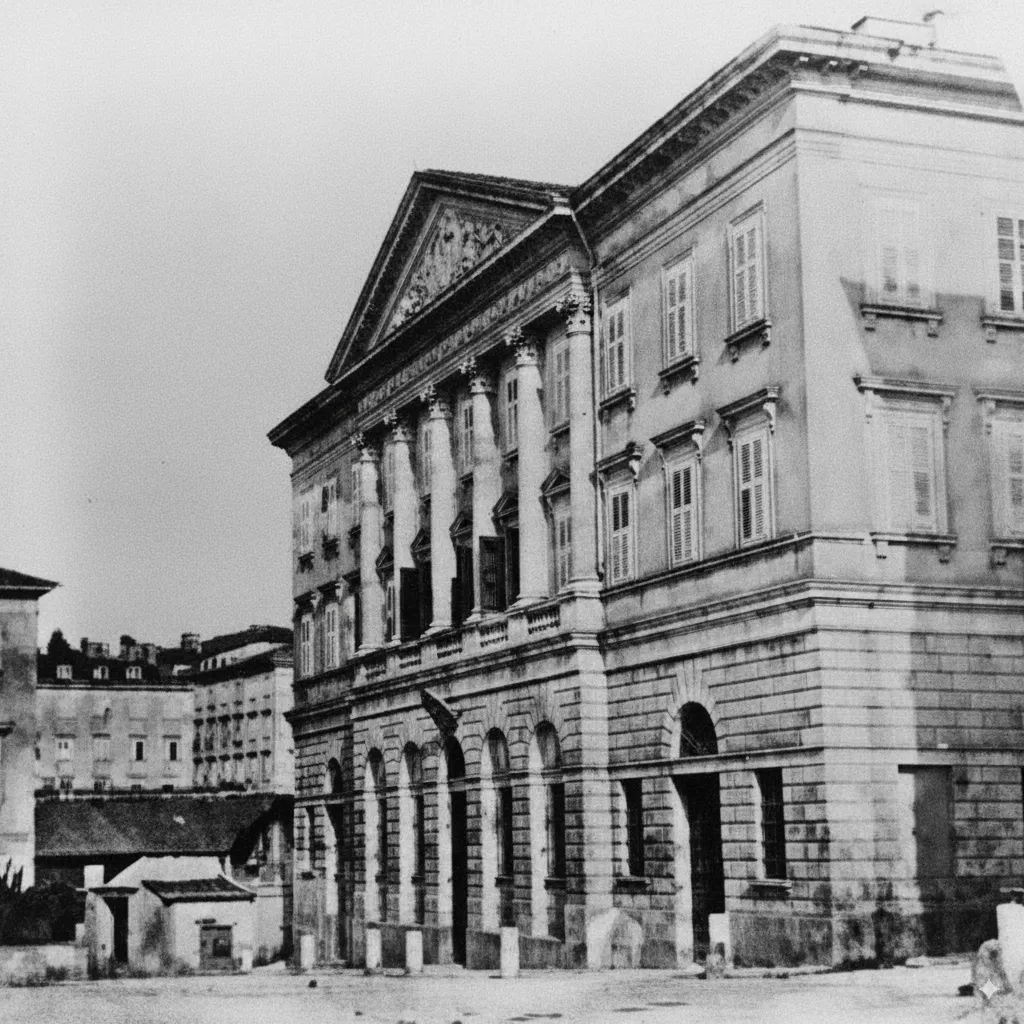
Palazzo Vivante is a building of great historical and architectural significance located in Trieste, known for its imposing neoclassical structure and for its relevant role in the city's history during the Habsburg period and the early post-war period.
Historical context and ownership
The construction of Palazzo Vivante took place between 1842 and 1844, based on a design by the architect Domenico Corti, in a period when Trieste was an important port of the Austro-Hungarian Empire and a commercial center of primary importance in the Mediterranean. The building was erected with a neoclassical layout, a style that was highly appreciated at the time in the city's civil architectures.
In 1904 the property passed to Fortunato Vivante, belonging to a family of merchants, bankers and insurers of French Jewish origin, who had been elevated to the rank of barons by Emperor Franz Joseph. The Vivante family chose Palazzo Vivante as their family residence and symbol of their economic and social prestige in Trieste.
Transformations and significant events
- During the Second World War, Palazzo Vivante suffered serious damage due to a bombing in the summer of 1945 which caused its temporary abandonment.
- In the same year, the building was used provisionally by Don Edoardo Marzari to accommodate young Istrian refugees, thus beginning a new phase of social use.
- In 1949 Palazzo Vivante became the property of the Opera Figli del Popolo for Social Assistance to Youth, engaged in social assistance activities.
- In 1952 the architect F. Vicentini directed the restoration works, restoring the building and highlighting the desire to preserve its historical magnificence, particularly visible in its noble halls, which retain the charm and richness of the construction period.
In the early post-war period, Palazzo Vivante had a role not only architectural but also social and cultural, representing a place of memory and regeneration for the Triestine community, with significant events such as the exhibition inaugurated in 1949 in the presence of figures like Senator Giulio Andreotti.
Curiosities and current state
Today Palazzo Vivante has been partly converted into a tourist accommodation structure, keeping intact its historical and architectural splendor. Its history intertwines elements of cultural significance, tragic war events and a narrative of continuity in the city of Trieste that makes it today a destination of interest for history enthusiasts and visitors.
Palazzo Vivante thus represents a living historical heritage, witness to the multiple transformations of Trieste from the XIX century to today and symbol of the social, cultural and architectural complexity of the city in the European context.