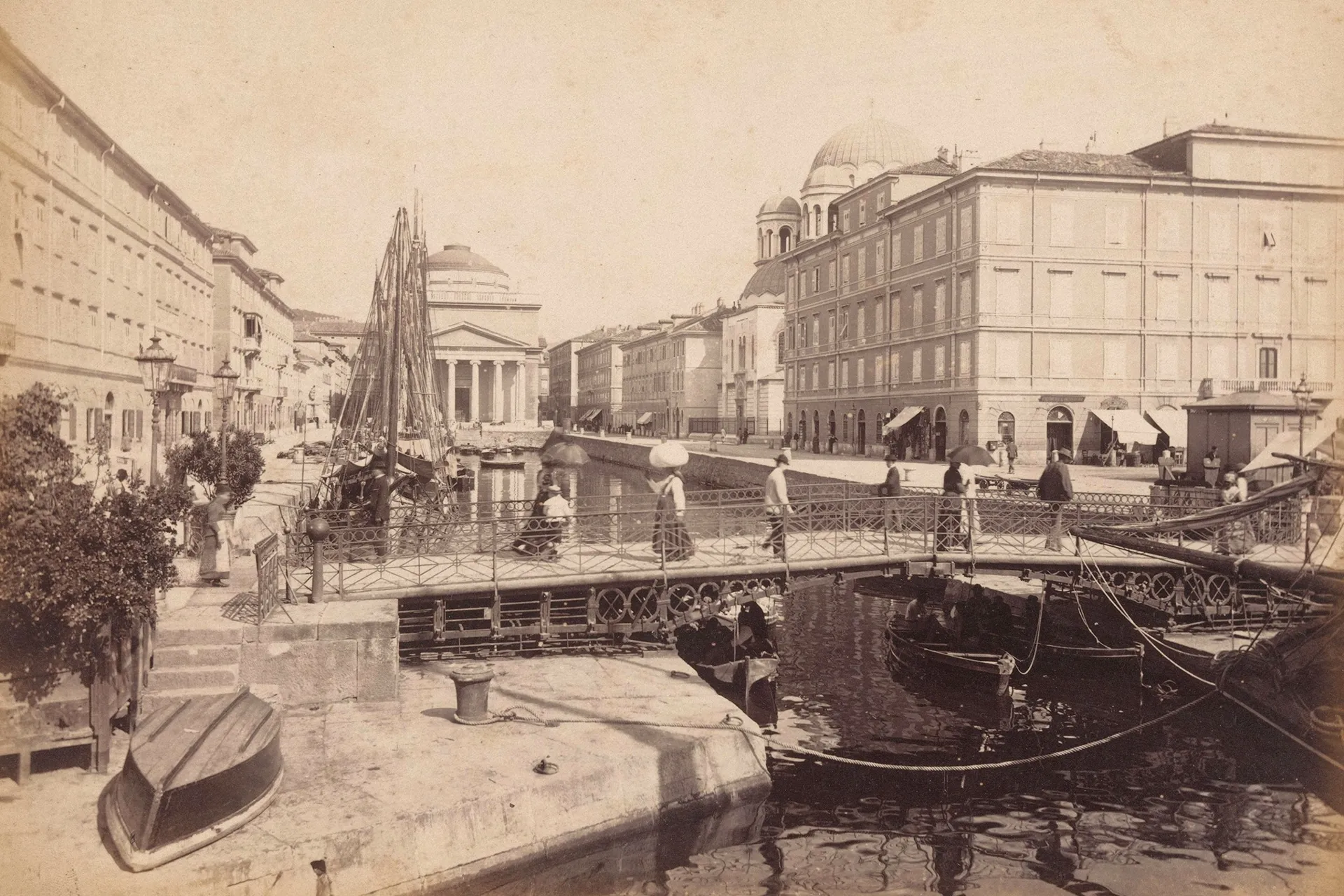
The Red Bridge is one of the historic bridges that cross the Canal Grande of Trieste, located in the central Piazza del Ponterosso. Its origin dates back to the period immediately following the construction of the canal, built between 1754 and 1756 under the direction of the Venetian Matteo Pirona, commissioned by the Habsburg State to excavate the ancient collector of the city's salt pans, transforming it into a navigable canal about 370 meters long.
Initial Construction
The Red Bridge was the first bridge built on the Canale Grande and was originally constructed in wood in 1756, just after the excavations of the canal itself were completed. At that time, it represented the only existing crossing on the canal, positioning itself as a fundamental link between the banks of the square, then the hub of an important urban development after the demolition of the ancient medieval walls ordered by Maria Teresa d'Austria in 1749 to start the town's expansion.
Replacement and Technological Advancement
In 1832, the wooden bridge was replaced by an iron structure, attributed to the architect Friedrich Bruyn, a sign of technological advancement and the growing importance of the bridge in the urban context. This iron version of the Ponte Rosso remained in use until 1925, highlighting a functional continuity and a deep connection with the political and commercial history of Trieste during the Habsburg Empire.
Origin of the Name
The name "Ponte Rosso" derives from the traditional coloring with which it was painted, in stark contrast to the other two historic bridges of the canal, the Ponte Verde and the Ponte Bianco (the latter so called in an irredentist key, although in reality it was gray), which together form a suggestive system of colored crossings along the city canal.
Symbolic Meaning and History of the Square
Ponte Rosso is not only an infrastructural element but also a symbol of the mercantile and social history of Trieste, located in a square that for centuries has performed various functions:
- from the area of the ancient salt pans transformed into an urban area;
- to the heart of a lively fish market;
- up to a place of cultural and political exchanges during the Cold War, when Piazza del Ponterosso represented a rare meeting point between Italy and Yugoslavia through markets and informal commercial relations.
The Red Bridge Today
Today, the Ponte Rosso remains an emblem of the city, a piece of history that tells of the Trieste of the eighteenth century, of its urban development under Habsburg domination and of the subsequent transformations, preserving the charm of a structure that has accompanied the social and architectural changes of a city crossroads of cultures and trades between Italy, Central Europe, and the Balkans.