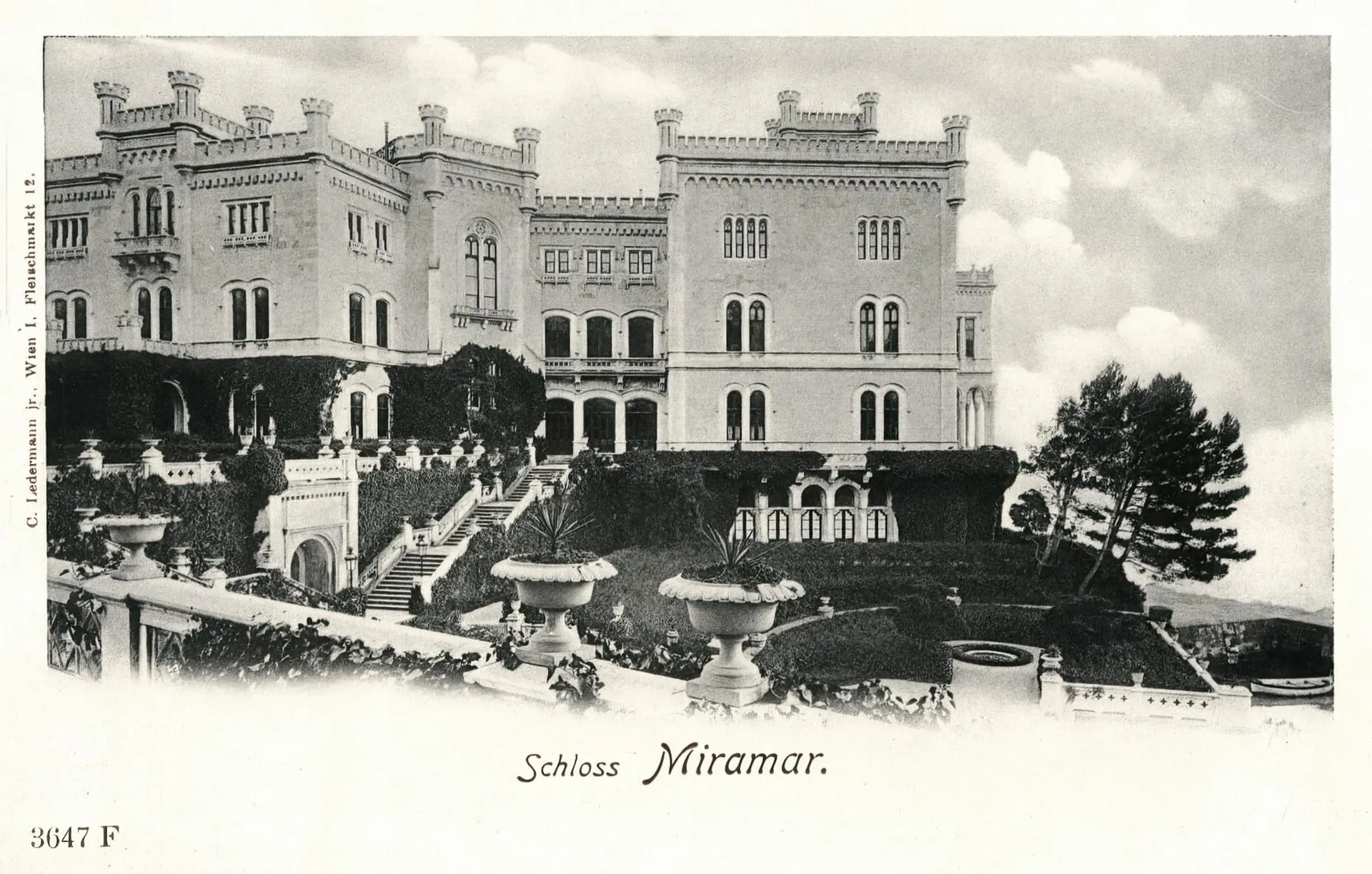
The Castello di Miramare is one of the most iconic and romantic places in Trieste, famous for its panoramic position overlooking the sea, its architecture and the tragic history of its first owners, Archduke Maximilian of Asburgo and his consort Charlotte of Belgium. Its story intertwines imperial dreams, passions, art and mystery, making it a symbol of nineteenth-century and Central European Trieste.
Origins and construction
The history of Miramare begins in 1855, when Archduke Ferdinando Maximilian of Austria, brother of Emperor Franz Joseph, decides to build a residence overlooking the Gulf of Trieste, in a position then isolated and wild, called Grignano. Maximilian, passionate about botany, art and travel, personally chooses the site and entrusts the project to the Austrian architect Carl Junker.
Work begins in 1856 and concludes in 1860 for the main body, while the park and accessory structures will be completed in subsequent years.
Architecture of the castle
The castle, in eclectic neo-medieval style, is inspired by European princely residences, with Gothic, Renaissance and Romantic references. The building develops over two floors, with a corner tower and large terraces overlooking the sea.
The richly decorated interiors reflect Maximilian's refined taste:
- Throne room: ceremonial space with original furnishings.
- Library: collection of books and historical documents.
- “Ship-style” bedroom: unique design inspired by maritime travels.
- Charlotte's sitting room: intimate space for the consort.
These spaces are still visitable today and preserve original furnishings.
The park and the greenhouses
The park of Miramare, of about 22 hectares, was designed by Maximilian himself with the help of gardeners and botanists, who imported rare plants from all over the world. The park is an example of a romantic English garden, with winding paths, ponds, greenhouses, statues and panoramic points.
Among the main structures:
- Castelletto: the first residence of the couple.
- Stables: for horses and carriages.
- Chapel: private place of worship.
- Tropical greenhouse: for exotic plants.
Maximilian and Charlotte: the myth and the tragedy
The castle was inhabited by Maximilian and Charlotte only for short periods, between 1860 and 1864. In 1864, Maximilian accepted the crown of Mexico, leaving with Charlotte for the new empire.
Their adventure ended tragically:
- Maximilian was shot in Querétaro in 1867.
- Charlotte, overwhelmed by grief, fell into deep madness and lived the rest of her life in isolation.
The story of the two young spouses, combined with the romantic and melancholic atmosphere of Miramare, has fueled legends and suggestions that still fascinate visitors and writers today.
After the Asburgo: military uses and museum
After Maximilian's death, the castle was sporadically inhabited by members of the Austrian imperial family, including Archduke Ferdinando d’Este.
During the Prima Guerra Mondiale it was occupied by Italian troops, then by the Austrians and finally by the Allies. In the post-World War II period it was the seat of the British and American command during the Free Territory of Trieste (1947-1954).
In 1955 the castle became a state museum, open to the public and dedicated to the memory of Maximilian and Charlotte, with original furnishings, paintings, photographs and historical documents. The park has been restored and today is one of the most visited in Italy.
The castle today
Today Miramare is one of the main tourist and cultural hubs of Trieste, a destination for visitors from all over the world. In addition to the museum and the park, it hosts temporary exhibitions, concerts and cultural initiatives.
Its image, suspended between history and legend, continues to inspire artists, writers and directors.
The Castello di Miramare thus remains a place of memory, beauty and mystery, a symbol of imperial Trieste and its international vocation.