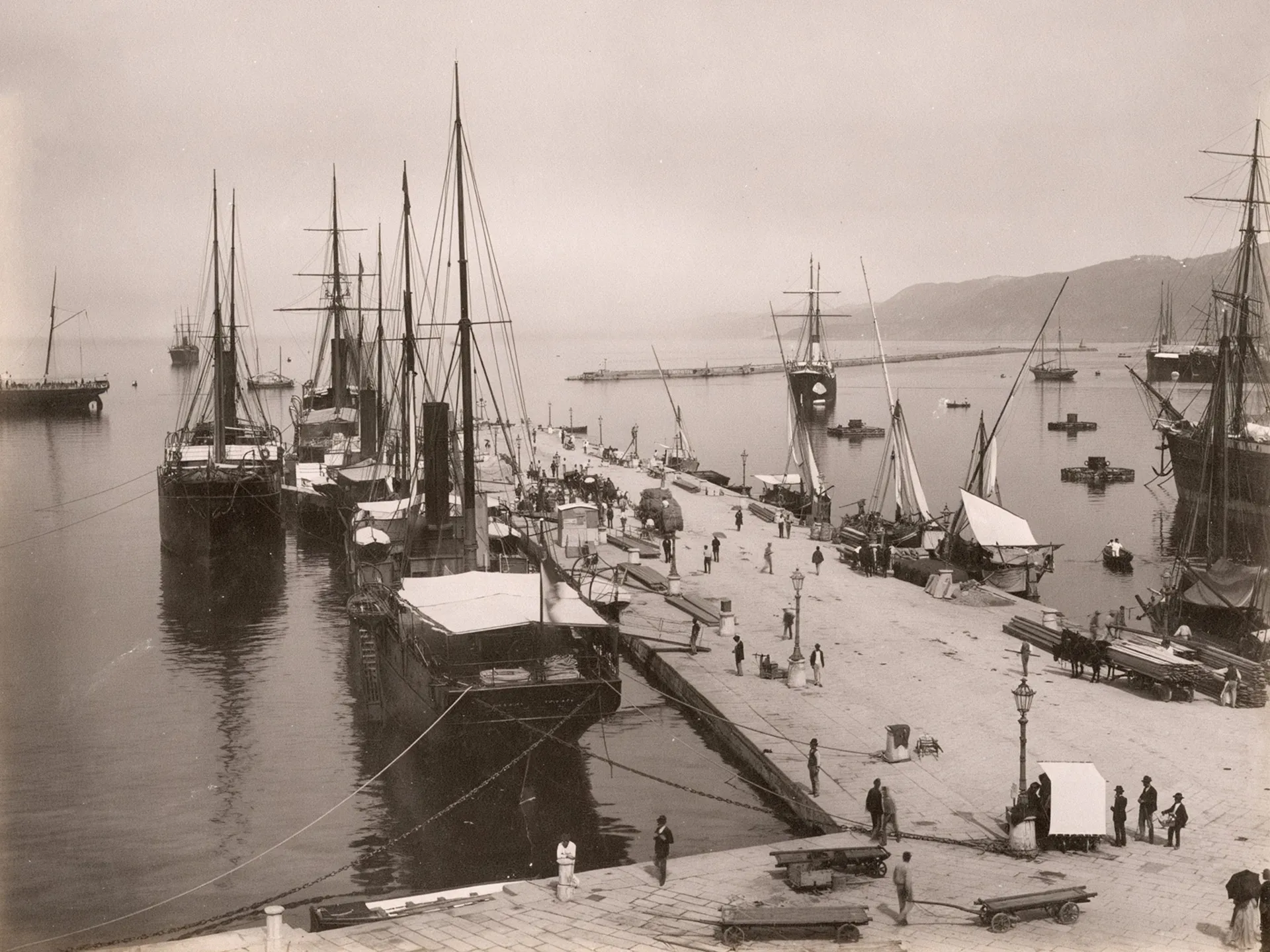
The Molo Audace, one of the most iconic and beloved spots in Trieste, lies in the heart of the city, just steps from Piazza Unità d'Italia. Its history reaches back to the 18th century and reflects the port, urban and symbolic transformations of the city.
Origins and construction
In 1740 the Austrian vessel San Carlo sank near the shore of the port of Trieste. Rather than removing the wreck, it was decided to use it as the foundation for a new pier, built between 1743 and 1751 and named after San Carlo.
Originally the pier was only 95 metres long and connected to the mainland by a small wooden bridge. Over the years it was progressively extended:
- by 19 metres in 1778,
- by a further 132 metres between 1860 and 1861,
reaching its present length of 246 metres. The bridge was removed, definitively joining the pier to the mainland, and a stone compass rose was added at its tip.
Port function and city life
During the Habsburg period, the Molo San Carlo was a key point for maritime traffic: both passenger and merchant ships docked here, amid an intense flow of goods, merchants and travellers from all over the world.
The pier separated the San Giorgio Basin from the San Giusto Basin of the Porto Vecchio (Old Port), becoming a true walkway over the sea and a meeting place for the citizens.
From the Great War to the change of name
On 3 November 1918, at the end of the First World War, the first Italian Navy ship to dock at the pier was the destroyer Audace: an event that, in the city's memory, marked the passage of Trieste to Italy.
In 1922 the pier was renamed Molo Audace in honour of the ship, and in 1925 a new bronze compass rose was placed at its tip, bearing an epigraph that recalls the landing and the words "Fusa nel bronzo nemico III novembre MCMXXV" ("Cast in enemy bronze, 3 November 1925"). One of the Audace's anchors is displayed at the base of the Faro della Vittoria (Victory Lighthouse).
Decline of the port function and revival as a symbolic place
As maritime traffic shifted to other areas of the port, the Molo Audace gradually lost its commercial function. Today it is a place for strolling and contemplation, loved by Triestines and tourists for its panoramic view over the Gulf and the city, and for its value as a "walkway suspended over the water" linking Trieste's history to its present.
The Molo Audace thus stands as a bridge between past and present, between historical memory and daily life, between sea and city, keeping intact its charm and its central place in the Triestine imagination.