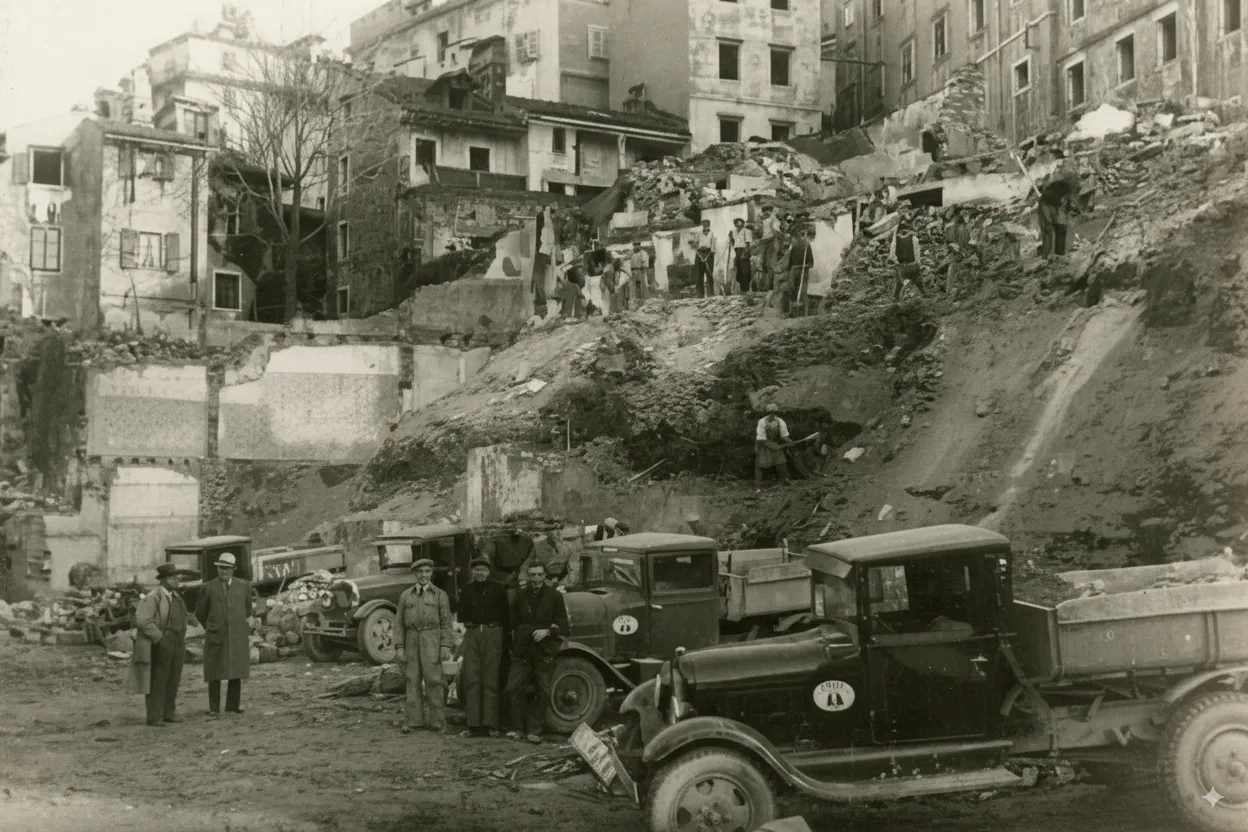
Demolitions of Cittavecchia: the Fascist Gutting of Trieste's Heart (1934-1938)
Between 1934 and 1938 the Fascist regime demolished 181 houses, 373 shops and four synagogues in Trieste's medieval heart, uprooting more than 2,000 families in the name of the 'pickaxe of redevelopment'.
When we walk today through the wide, sunlit space of Piazza Cavana or look out over the Roman Theatre from Via del Teatro Romano, we are standing on a wound. Between 1934 and 1938 the Fascist regime, under the slogan of the 'pickaxe of redevelopment' (piccone risanatore), demolished an entire portion of Trieste's medieval and Renaissance core — the area known as Cittavecchia. Behind the rhetoric of public hygiene and Italian modernity lay one of the most violent urban transformations of any Italian city of the twentieth century: 181 houses razed, 373 shops and warehouses cancelled, four synagogues erased, and more than 2,000 families uprooted from the streets where they had lived for centuries.
A working-class quarter before the pickaxe
Life in the medieval core
Before the demolitions, Cittavecchia was a dense weave of androne, narrow courtyards, medieval bifore and Renaissance loggias clustered around three landmarks: the Roman Arco di Riccardo, the cathedral of San Giusto and the Borsa Vecchia. The population was working-class and cosmopolitan — Corfiot Jews, dockworkers, Slovenian and Friulian labourers, Greek and Levantine traders — packed into buildings that the bourgeois press of the time described as squalid but which the historian Diana De Rosa would later document as a living, multilingual urban tissue.
A 'problem' for the Italian city
After the 1918 annexation, Trieste lost its role as the principal port of the Habsburg Empire and entered a long economic crisis. The Italian middle class, frustrated by the loss of imperial functions, projected its anxieties onto Cittavecchia: the vicoli (alleys) became a metaphor for everything 'backward', 'unhygienic' and non-Italian about the city. Fascist propaganda translated this resentment into urban policy.
The political stage: Salem and the 'border Fascism'
A Jewish Podestà for a Fascist Trieste
On 21 October 1933 the regime nominated Enrico Paolo Salem as podestà of Trieste. A bank administrator of Sephardic origin, Salem represented a compromise between the revolutionary wing of local Fascism and the conservative liberal establishment. He was, with Renzo Ravenna of Ferrara, one of the only two Jewish podestà of Fascist Italy. The paradox that would later mark his life was already visible in 1934: Salem was the man who signed the order to demolish the synagogues of the ghetto, and he was also a Jew. He resigned on 10 August 1938, weeks before the racial laws came into force.
The rhetoric of redevelopment
In the Fascist press of Trieste — Il Popolo di Trieste in particular — the demolitions were celebrated as a 'rivendicazione archeologica', a reclamation of the Roman past from the medieval squalor. The pickaxe was framed simultaneously as a tool of hygiene, of nationalism and of monumental rebirth.
The 1934 Master Plan: Grassi, Jona and Piacentini
From the Habsburg dreams to the Fascist plan
Cittavecchia had been the object of architectural fantasies since the Habsburg era — Prevosti, Comelli, Escher had all proposed selective interventions. But it was the engineer Paolo Grassi who, between 1925 and 1932, drafted first the Piano di dettaglio for Cittavecchia and then the Piano di demolizione. With architect Camillo Jona he developed the full master plan, approved on 10 May 1934 by Royal Decree-Law n. 989 — the first General Master Plan in Trieste's history.
Piacentini's monumental hand
The Roman architect Marcello Piacentini, already the regime's favourite urbanist, acted as consultant. He pushed for the creation of monumental axes and signed the new façade of the Palazzo delle Assicurazioni Generali on Corso Vittorio Emanuele III. The plan envisaged:
- Largo Riborgo (initially Piazza Malta), a new square at the heart of the gutted area
- the extension of via Roma from the Borgo Teresiano towards Piazza Unità
- the demolition of the entire block behind the Palazzo del Municipio, facing Via di Riborgo, to expose the Roman Theatre
- a system of new buildings in stile fascista to surround the archaeological remains
The chronology of destruction (1932-1938)
From paper to pickaxe
- 1925: Grassi presents the Piano di dettaglio
- 1932: approval of the Piano di demolizione for Cittavecchia
- 10 May 1934: Royal Decree-Law n. 989 makes the General Plan executive
- 1934-1937: peak of demolitions in the area between Piazza della Borsa, via di Riborgo, via Donota, via Malcanton and via Crosada
- 1937: construction of the right wing facing via Malcanton is approved
- 1938: last large-scale demolitions in via S. Maria Maggiore
The numbers
Between 1934 and 1937 the piccone destroyed:
- 181 dwellings
- 1 stable and 1 hotel
- 373 warehouses and shops
- the whole of Piazzetta Trauner, via Crosada, via Piccola Fornace
- the trecento-era Casa Montecchi (1438) in via S. Maria Maggiore 2
- Casa Piccardi (1514) and the Casa dei Bavaresi
- medieval bifore from the XIII-XIV century, documented and then demolished, in the Casa Vianello of via Malcanton 7
Night-time demolitions and the Soprintendenza
Demolitions often took place at night, justified to the Soprintendenza ai Monumenti as 'sudden collapses'. The technique was deliberate: by the time the Soprintendenza could inspect, the historic façade had already been reduced to rubble. Among the very few public opponents was the dialect poet Raimondo Cornet ('Corrai'), who openly mocked the 'Podestà Piccon'.
The erasure of Jewish Trieste
Four synagogues lost
The most violent ideological act of the demolitions was the erasure of the historic synagogues of the ghetto, in particular the Tempio Maggiore built in 1798 in via delle Beccherie (today the area behind the Questura) to a design by Francesco Balzano in Venetian style. The building housed two Schole inside it — the Schola Spagnola of Sephardic rite (Schola n. 3) and the Schola Grande of Ashkenazi rite (Schola n. 2) — demolished respectively in 1928 and 1934. The new synagogue in via Donizetti, opened on 27 June 1912 to a design by Ruggero and Arduino Berlam, had ritually replaced them — but did not justify their physical erasure.
Before the racial laws
This is the deepest paradox of the piccone risanatore: the Fascist regime cancelled the buildings of Triestine Judaism before the racial laws of 1938. The pretext was hygiene; the substance was a cultural pre-emption. A single trace of one ghetto synagogue is still visible today, embedded in a wall of Piazzetta Bronzin.
Roman archaeology, medieval losses
The 'reclamation' of Tergeste
The most photographed result of the demolitions is the Roman Theatre, liberated between July 1937 and September 1938 after demolishing the block between via Riborgo and via Donota. The cult of romanità drove the entire operation: the levellings on the colle di San Giusto for the Monumento ai Caduti revealed a Roman basilica from the second century AD; the excavations in Corso Vittorio Emanuele III brought to light a Roman pavement and the sepulchral cippus of Quinto Mario Nomi, member of an Aquileian family. The Arco di Riccardo, already standing, gained finally the open space the regime considered worthy of an imperial relic.
Medieval losses
For every Roman stone recovered, an entire century of post-classical Trieste was destroyed. The bifore of Casa Vianello, decorated wells, mullioned windows, courtyards, balconies, all the Adriatic Gothic and Venetian Renaissance layers of Cittavecchia were ground into the bins of construction debris.
A demographic drama
Two thousand families displaced
The human consequence was enormous. More than 2,000 families were forcibly relocated, the population of the historic core was halved, and a multi-secular network of relationships, dialects and trades was dismantled in five years. The Comune paid for the relocations — but at a price: the displaced families were dispersed into the new case popolari of the periphery.
The new periphery
Most of the displaced ended up in the working-class neighbourhoods of Ponziana, San Giacomo and Valmaura, in newly built housing managed by the ICAM (Istituto Comunale Abitazioni Minime, founded in Trieste in 1902, today merged into ATER) — rationalist blocks far from work, far from the cafés, far from the social geography in which these families had functioned for generations.
What remained and what was lost
The completed works
Of the original plan, only fragments were realised:
- Largo Riborgo (former Piazza Malta), with the surrounding buildings in stile littorio
- the Casa del Fascio and a few public palaces
- the excavation and museification of the Roman Theatre and of the Arco di Riccardo
- the new façade on Piazza della Borsa designed by Piacentini
The permanent voids
Many lots remained empty for decades. Where medieval houses had stood, the post-war city deposited parking lots, anonymous service buildings, asphalt. Only from the 1980s did a slow campaign of restoration begin, recovering façades, reopening androne, signposting the archaeological discoveries.
Memory of stone
The historiographical debate
The book that crystallised the contemporary debate is 'Memorie di pietra. Il ghetto ebraico, città vecchia e il piccone risanatore: Trieste 1934-1938' by Diana De Rosa, Claudio Ernè and Mauro Tabor (Comunicarte, 2011). It documents the demolitions house by house, using the archive of Il Popolo di Trieste and the registers of relocations.
What the photographs preserve
The visual archive of Trieste Storica preserves dozens of images of via Riborgo, of Casa Montecchi, of Piazzetta San Giacomo and of the Sinagoga in demolition. They are the only counter-memory we have against the official record of the 'pickaxe of redevelopment': a slow, deliberate, ideologically motivated erasure that, eighty-five years later, still defines the silhouette of Trieste's historic centre.
Walking today through Largo Riborgo, via Cavana or in front of the Roman Theatre, what we see is not simply what is: it is also, indelibly, what no longer is.