Shipbuilding in Trieste: from 18th-century yards to Habsburg battleships
Three centuries of shipbuilding in Trieste: from the 1719 free port and artisan yards to the Stabilimento Tecnico Triestino and the battleships of the k.u.k. Kriegsmarine.
To understand shipbuilding in Trieste we have to start from the sea, and from a decision taken in Vienna. When Charles VI granted Trieste the status of a free port in 1719, he did far more than open the city to trade: he created the need for ships, and therefore for the men and yards capable of building them. For nearly three centuries the slipways along this stretch of the Adriatic launched merchant steamers, ocean liners and, in the end, the steel battleships of an empire.
18th-century origins: from the free port to the first yards
At the start of the eighteenth century Trieste was little more than a fishing town with modest yards. The free-port patent of 1719 changed the scale of everything. That same year the Oriental Company was founded in Vienna; needing its own fleet, in 1720 it bought land outside the city walls, in the salt-marsh area, and built a yard with timber and material stores. In 1723 the Austrian government took it over to build an arsenal, later transferred to Fiume, and the yard was demolished around 1740.
For decades the only permanent yard left was the small Squero di San Nicolò, run by the confraternity of the same name. The cultural infrastructure grew alongside it: in 1753 Maria Theresa founded the Imperial-Royal Nautical School in Trieste. In 1770 the management of the San Nicolò yard passed to Giuseppe (Odorico) Panfilli; when urban growth forced its closure in 1789, the activity moved to the Squero Panfilli, enlarged in 1788. With thirteen slipways, eight of them for large vessels, it was for half a century one of the best-equipped facilities in the Mediterranean. It launched the Carolina (1818), capable of nine miles an hour, and the Civetta, the first propeller-driven ship of the area.
The industrial turn: Gaspare Tonello and the San Marco yard
Modern shipbuilding in Trieste begins with one man. Gaspare Tonello arrived from Venice in 1819 to teach naval construction at the Nautical School, and over thirty years he trained an entire generation of builders. Having acquired and reclaimed nearly thirty thousand square metres of shoreline towards Chiarbola, with an investment of 125,767 florins, he officially founded the Cantiere San Marco on 21 March 1840. On 2 September the yard launched its first ship, the Primogenito. This was the true turning point: the passage from artisan construction to industrial, serial production.
The yard found its footing thanks to large orders from the Austrian Lloyd (founded in Vienna in 1836), for which Tonello built the steamers Trieste and Venezia in 1842. But Tonello was a great engineer, not a financier. After his sudden death in 1849, management passed to his brother Giuseppe, and in 1851 the Austrian navy expropriated San Marco for 49,000 florins, intending to move the whole operation; the imperial arsenal was eventually established at Pola instead, and in 1861 Giuseppe Tonello bought the yard back for 70,000 florins.
The great poles: Lloyd Arsenal and the Stabilimento Tecnico Triestino
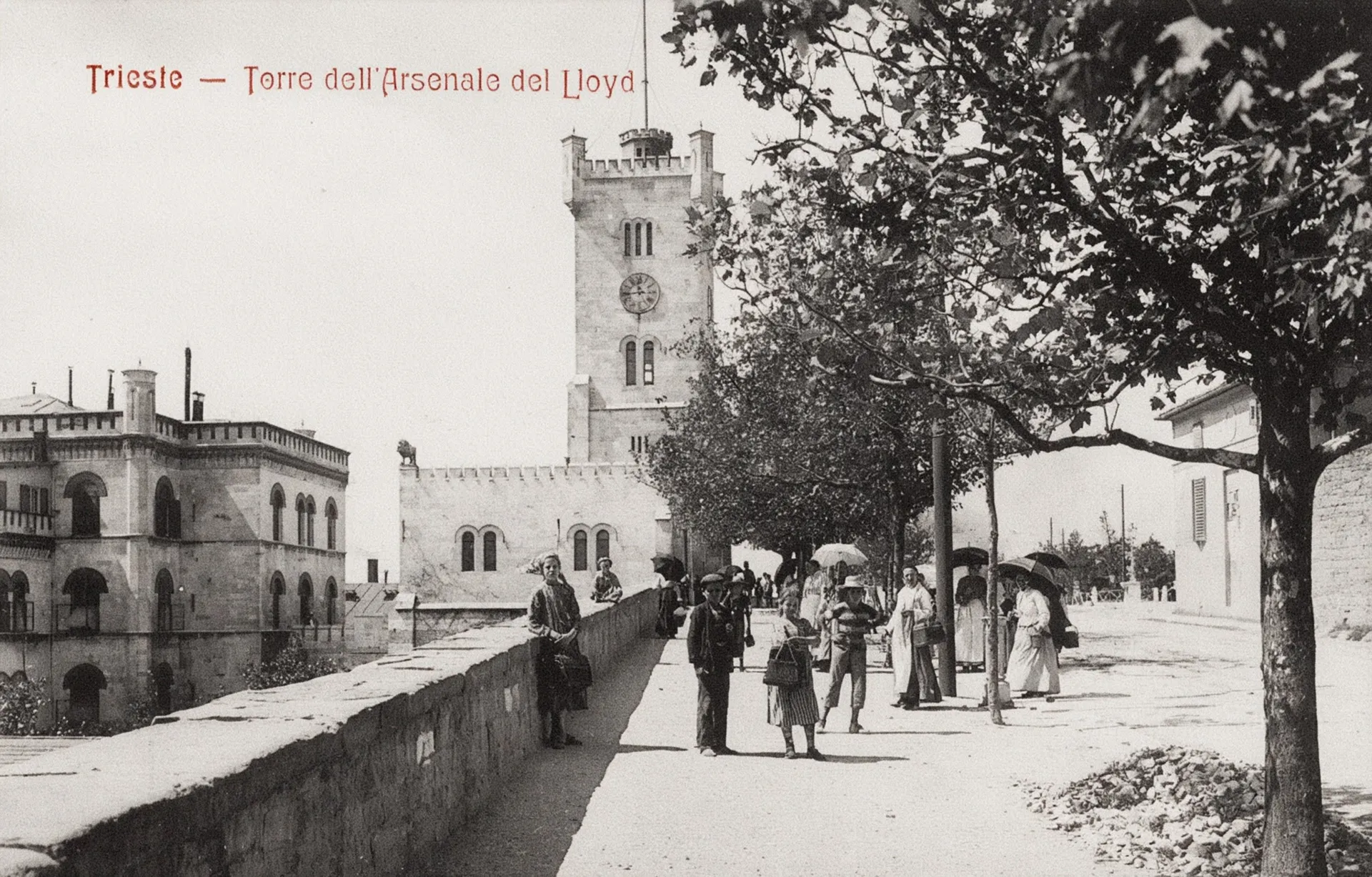
As Trieste's traffic grew, two industrial complexes came to dominate. The first was the Lloyd Arsenal. The Austrian Lloyd had opened a repair workshop near the old lazaretto as early as 1837; in 1853 it decided to build a large, modern yard in the bay of Muggia. The first stone was laid on 30 May 1853 in the presence of Archduke Ferdinand Maximilian. Designed by the Danish architect Hans Christian Hansen, the complex cost an extraordinary 6.5 million florins and was completed around 1861. With four slipways and two basins it could in principle handle a hundred ships a year; its first launch was the Egitto (1863), followed in 1865 by the Austria, the first iron ship of the empire, at 1,700 tonnes. You can still read its story in our entry on the Arsenale del Lloyd, and its broader context in the essay on the Lloyd Austriaco.
The second pole grew from the workshops of Georg Strudthoff, who opened an engine-repair shop in 1830 and the Sant'Andrea machine factory and foundry in 1835. In 1857 he founded the Cantiere San Rocco on the Muggia shore, and in 1858 his enterprises merged into a single industrial complex: the Stabilimento Tecnico Triestino (STT). The timing was perfect. In 1857 the Southern Railway (Südbahn) finally linked Vienna to Trieste, by then the empire's principal port and, more broadly, the heart of its maritime economy near the Porto Vecchio.
The STT kept expanding. In 1895 it took over the old San Marco yard, better positioned and closer to the Sant'Andrea works; after two years of modernisation, the first launch under the new management came in 1897. Among the figures who shaped this financial and industrial world was the Barone Pasquale Revoltella, one of the great patrons of Habsburg Trieste.
The military apogee: battleships for the k.u.k. Kriegsmarine
The most spectacular chapter belongs to the warships. The naval arms race with Italy began in 1860, when Archduke Ferdinand Maximilian ordered the first Austrian ironclads, the Drache class. The Salamander, commissioned in May 1862, cost a staggering 2.3 million florins — over six times the price of earlier warships. Designed largely by Josef von Romako, the Erzherzog Ferdinand Max and the Habsburg followed from the STT in 1863.
Over the following decades the Trieste yards built a remarkable sequence of warships for the imperial fleet:
- the armoured cruisers of the Kaiserin und Königin Maria Theresia class, launched at San Rocco from 1893;
- the Habsburg-class battleships (Habsburg, Árpád, Babenberg), launched at San Marco from 1900;
- the Erzherzog Karl class, launched between 1903 and 1905;
- the Radetzky-class battleships (Erzherzog Franz Ferdinand, Radetzky, Zrinyi), between 1908 and 1910.
The climax was the Tegetthoff class, also called the Viribus Unitis class: four dreadnought battleships, three built at the STT in Trieste and one at the Danubius yard in Fiume. The lead ship was to be named for Admiral Wilhelm von Tegetthoff, victor of the Battle of Lissa, but it was renamed Viribus Unitis after Franz Joseph's motto, the name Tegetthoff passing to the second unit. The SMS Viribus Unitis was launched on 24 June 1911, the Tegetthoff on 21 March 1912, and the Prinz Eugen on 30 November 1912.
Towards 1914: workforce, infrastructure and the end of an era
By the eve of the First World War the Trieste shipbuilding district was an industrial machine of imperial scale. In 1910 the San Marco yard began building the giant floating crane Ursus, designed to lift the boilers and gun turrets of battleships — though the war halted its completion. The San Rocco yard, reorganised as a joint-stock company in 1910 (half Lloyd, half STT), had five basins by 1914 and its own works for engines, boilers and Parsons turbines built under British licence. Its workforce climbed from roughly 2,700 to about 3,200 workers in the pre-war years.
Then everything stopped. When Italy entered the war in 1915, the STT took the German name Austriawerft, and the contracts for new battleships and submarines were cancelled that same year, as skilled technicians and workers were called to arms. The age that had begun with a free-port patent in 1719 closed in the smoke of a world war — but the slipways of Trieste had, by then, written one of the great chapters of European shipbuilding.