The Foreign Merchant Communities of Trieste: Greeks, Serbs, Jews and Armenians
After the Free Port declaration of 1719, Greeks, Serbs, Jews and Armenians transformed Trieste into a cosmopolitan city. Churches, palaces and legendary families: the story of the communities that shaped the city's identity.
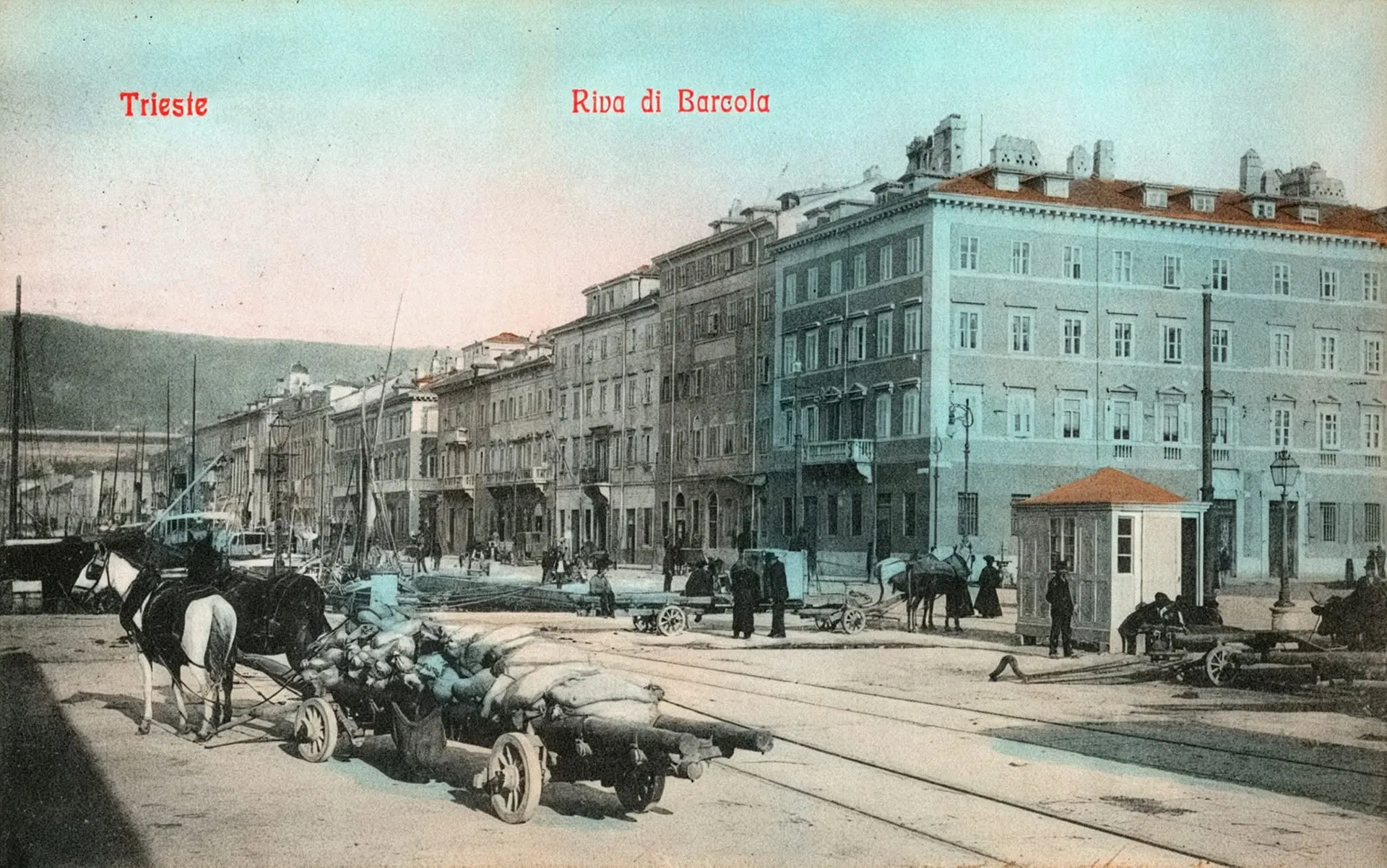
Few cities in the Mediterranean can claim a transformation as radical as the one that reshaped Trieste starting in the early eighteenth century. When Emperor Charles VI of Habsburg signed the patents of 15 and 18 March 1719, declaring Trieste a Free Port, he set in motion a process that would turn a modest Adriatic town into one of Europe's most cosmopolitan trading centres. The foreign merchant communities of Trieste — Greeks, Serbs, Jews and Armenians — were the living engine of this metamorphosis.
The Free Port and the Habsburg Vision of Tolerance
The Patents of Charles VI (1719) and Free Trade
The idea of establishing a free port in Trieste took shape in 1717, when Charles VI declared freedom of trade in the Adriatic. The Treaty of Passarowitz with the Ottoman Empire, signed the same year, encouraged the free circulation of goods across Habsburg territory. The two imperial patents of March 1719 granted merchants who settled on the "shores and ports of Inner Austria" the right to "freely and without any impediment exercise navigation, equip merchant vessels and conduct their trade." They were offered the imperial flag, lodgings, and widened roads to ensure safety of commerce.
Religious Tolerance: From Maria Theresa to Joseph II
A crucial factor was the deliberate religious tolerance practised by the Habsburgs. On 20 February 1751, Empress Maria Theresa granted the Orthodox congregation freedom of worship and permission to build a church. In 1771 she abolished the Jewish ghetto. Her son Joseph II extended these principles with his Edicts of Tolerance in 1781, allowing Lutherans and Reformed Christians their own places of worship. This mosaic of faiths — Orthodox, Catholic, Jewish, Protestant — became the hallmark of the Trieste cityscape.
Pioneers from the Levant: The Greek Community
From Liberale Baseo (1714) to the Orthodox Community
The first Greek merchant, Liberale Baseo, arrived from Nauplia in 1714, five years before the Free Port was even declared. Nicolò Mainati from Zakynthos followed in 1734 and founded an Orthodox community around 1750 that included both Greek and Illyrian (Serbian) faithful. In 1751, Archimandrite Omero Damasceno obtained permission to build a church dedicated to Saint Spyridon on the Grand Canal, completed in 1753.
The Church of San Nicolò dei Greci and Pertsch's Facade
On 2 August 1782, the exclusively Greek-Orthodox community was officially established. Construction of their own church on the waterfront began in 1784, and the first liturgy was celebrated on 18 February 1787, officiated by Bishop Anthimos Karakalos of Modon. The church, dedicated to Saint Nicholas — patron of sailors — and the Holy Trinity, was officially inaugurated in 1795 in the presence of governor Pompeo de Brigido. The austere original facade was later redesigned in neoclassical style between 1819 and 1820 by architect Matteo Pertsch, called to Trieste by Demetrio Carciotti himself.
Demetrio Carciotti and His Palace-Manifesto on the Grand Canal
Demetrio Carciotti, a native of the Peloponnese, arrived in Trieste from Smyrna around 1771–1775 and quickly amassed a fortune. Giacomo Casanova described him as "the most apt and solid merchant I know for the sale of Waldstein fabrics in the Levant." In 1797, Carciotti summoned the young architect Matteo Pertsch and sculptor Antonio Bosa — only 20 years old — from Milan to build his monumental palace on the Grand Canal. The building was not merely a residence but a palazzo di rappresentazione: its six rooftop statues — Mercatura, Giustizia, Onore, Fama, Ingegno, Abbondanza — proclaim the values of its owner. Architectural historian Henry Russell Hitchcock called it "one of the most imposing and successful Italian buildings of the early century."
The Great Families: Scaramangà, Economo, Ralli and the Lloyd Austriaco
The Greek contribution extended far beyond a single family. Merchant dynasties such as the Scaramangà, the Ralli, the Economo and the Galati established shipping companies, insurance institutions — notably the founding of RAS (Riunione Adriatica di Sicurtà) by Giannichesi — and were among the founders of the celebrated Lloyd Austriaco (later Lloyd Triestino). The Galati family donated the San Giovanni estate that became Trieste's psychiatric hospital; the Manussis family promoted the children's hospital later named Burlo Garofolo. At its peak, the Greek community numbered some 5,000 members.
Merchants from the Other Shore: The Serbian Community
Arrivals from Sarajevo, Trebinje and Kotor
Serbian merchants and shipowners began settling in Trieste from the mid-eighteenth century, most arriving from Sarajevo, Trebinje and the Bay of Kotor. By 1766, there were 50 Serbs; by 1780, some 200. The wealthiest families — Kurtović, Gopčević, Vojnović and Miletić — owned much of the Porto Vecchio infrastructure.
The Greek-Illyrian Split of 1782
Initially, Greeks and Serbs worshipped together in the shared church of Saint Spyridon. However, from 1769 the growing Serbian community insisted on using the Serbian language in the liturgy, which led to irreconcilable tensions. In 1781–1782, the two groups officially separated: the Greeks went on to build their church of San Nicolò, while the Serbs retained the original Saint Spyridon.
The Temple of Saint Spyridon: From 1753 to the Neo-Byzantine Monument
As the Serbian congregation grew, the original 1753 church proved unstable and too small. It was demolished in 1861, and an international competition was held. The Milanese architect Carlo Maciachini won with a monumental neo-Byzantine design. Construction lasted from 1861 to 1869, with the definitive consecration on 24 December 1885. The church, built of stone from the Karst, Brioni, Carrara and Verona, seats 1,600 worshippers and features an interior richly decorated with oil paintings imitating mosaics. Among its treasures is a silver lamp donated in 1782 by Pavel Petrovich Romanov, the future Tsar Paul I of Russia.
Gopčević, Miletić and Serbian Cultural Patronage
The Serbian community's impact extended well beyond commerce. In 1787, the wealthy merchant Jovan Miletić donated 24,000 florins to establish a Serbian elementary school, which officially opened on 1 July 1792 beside the church of Saint Spyridon. Trieste became a magnet for Serbian intellectuals: Dositej Obradović, considered the father of modern Serbian literature, taught the children of wealthy Serbian merchants; Vuk Karadžić, the linguist who standardised the Serbian language, maintained constant contact with the Trieste community from Vienna. The Gopčević family built Palazzo Gopcevich on the Grand Canal in 1850, decorated with motifs celebrating Serbian independence heroes.
From Emancipation to a Great Temple: The Jewish Community
The Riborgo Ghetto and Its Abolition in 1771
The Jewish community of Trieste had long been confined to the ghetto in the Riborgo quarter, celebrating worship in four small synagogues. In 1771, Empress Maria Theresa issued Sovereign Patents that granted Jews of Trieste greater freedoms — residence rights, property ownership, and employment in commerce and the arts. The ghetto gates were opened.
Transatlantic Commerce: From Grahl to Da Ponte
The Jewish role in Trieste's commercial expansion reached surprising breadth. Johann Grahl, a Jewish merchant originally from Dresden, relocated to Trieste and in 1784 helped found the first mercantile company linking Trieste to the United States, with the blessing of Thomas Jefferson himself. His son-in-law was none other than Lorenzo Da Ponte — Mozart's celebrated librettist — who emigrated to New York in 1810 and reactivated his Triestine networks for transatlantic trade.
The Berlam Synagogue (1908–1912): Second Largest in Europe
As the community's importance grew, the four modest ghetto synagogues no longer sufficed. An international competition in 1903 failed to produce a worthy project, so the commission was entrusted to Trieste's most celebrated architectural firm: father Ruggero and son Arduino Berlam. Construction began in 1908 and the monumental Synagogue, in Sephardic style with Art Nouveau interiors, was inaugurated on 21 June 1912. It remains among the largest synagogues in Europe, second only to Budapest. Tragically, in 1938 the Fascist racial laws forced its closure; during the German occupation, it was used as a depot for art looted by the Nazis.
A Forgotten Community: The Armenians of Trieste
The Mechitarist Fathers from Venice (1773)
The year 1773 is traditionally considered the founding date of the Armenian community in Trieste, when a group of Mechitarist fathers, who had broken away from the island of San Lazzaro in Venice, arrived with the ambition of establishing a printing house — a natural extension of the Mechitarist motto ora et labora et studia.
Maria Theresa's Statute and the Fragile Settlement
On 30 May 1775, Maria Theresa granted a Statute to the Armenian nation in Trieste, and the small community began to grow. In 1774, around 30 Armenian laypeople and the monks resided in the city; by 1780–1790, numbers reached roughly 100. Merchants arrived from Venice, Livorno, Constantinople, Cairo and Persia. Yet unlike the Greeks and Jews, who integrated deftly into the city's commercial fabric, the Armenian community remained culturally insular, fiercely guarding its traditions and struggling with both German and Italian — the two languages essential for dealing with the Habsburg bureaucracy and the mercantile world.
The Napoleonic Occupations and the Community's End
This promising beginning was cut short by the three Napoleonic occupations of Trieste. During the third, in 1810, the Mechitarist order was shut down, and without its religious nucleus the community lost its cohesion. Among the Armenian families that remained was the Hermet family; a distant descendant, Francesco Hermet, is remembered today in a Trieste street name. The Armenian church, built in 1859 during a second, briefer phase of the community, eventually passed to the German-speaking Catholic community and today stands abandoned.
The Visible Legacy: Churches, Palaces and Living Communities
The Architectural Heritage of the Foreign Nations
Walk through Trieste today and the foreign merchant communities are everywhere. The neo-Byzantine blue domes of Saint Spyridon rise above the Grand Canal. The neoclassical facade of San Nicolò dei Greci surveys the waterfront. The monumental Synagogue dominates Piazza Virgilio Giotti. Palazzo Carciotti anchors the canal entrance with its rooftop allegories and cupola — now envisioned as a future hub for artificial intelligence. The Greek Orthodox Cemetery at Sant'Anna preserves the tombs of those who built this cosmopolitan legacy.
The Communities Today
The communities that shaped Trieste are not relics. The Serbian community is today the city's largest minority of foreign origin — estimated between 2,000 and 18,000 — reinvigorated by immigration following the Yugoslav Wars of the 1990s. They maintain the school tradition with the Vuk Karadžić cultural association and the annual Guča na Krasu trumpet festival. The Greek-Orthodox community, now some 600 members, continues its liturgical and educational activities. The Jewish community preserves its history through the Morpurgo Tedeschi school and the Carlo e Vera Wagner Museum. Together, they testify that Trieste's cosmopolitan soul was not a historical accident but a deliberate, and enduring, choice.