Tergestino dialect: the ancient Romance language of Trieste before the free port
Tergestino was a Rhaeto-Romance language related to Friulian, spoken in Trieste for centuries until the nineteenth century. Overwhelmed by Venetian after the 1719 free port, it survives in place names and in Mainati's Dialogues.
When a Triestine today says bora or jota, putel or xe, they think they are speaking Triestino. Yet the dialect of Trieste as we know it today is essentially a Venetian variety — imported, mercantile, relatively recent. Before that, for more than a thousand years, Trieste spoke another language entirely: the dialetto tergestino, a Rhaeto-Romance idiom related to Friulian and to the Muggia dialect, the autochthonous voice of the old city under the Castello di San Giusto. Submerged by the demographic explosion that followed the free port of 1719, the tergestino is today an extinct language — but its imprint survives in 60% of Triestine place names and in a handful of texts that allow us to listen to it again.
A Rhaeto-Romance language at the edge of the Adriatic
Where the tergestino comes from
The tergestino derives from the vulgar Latin of Tergeste — the Roman name of the city, of probable Venetic-Illyrian origin (from the root terg-, 'market'). The Roman colony, founded in the first century BC, transmitted its Latin not to a Venetian-style sphere but to the Romance continuum of Friuli, Ladin Dolomites and Swiss Romansh. From the high Middle Ages onwards, Trieste, Muggia and the Carnic uplands shared a common Rhaeto-Romance background.
The Rhaeto-Romance family
Linguists classify the tergestino as the south-eastern branch of the Rhaeto-Romance group, together with the (also extinct) muglisano of Muggia. Its closest living relative is the western Friulian. Distinctive phonological and morphological features included:
- Friulian vocalism: diphthongs such as biel (beautiful), gruessa (big, feminine)
- Palatalisation of velars: the sounds cj and gj before vowels (as in modern Friulian)
- Feminine plural in -s: lis tredis ciasadis (the thirteen households)
- Conservation of Latin -s in nominal endings — completely absent in Venetian
As early as 1654, Bishop Giacomo Filippo Tommasini of Cittanova summarised the perception of his contemporaries with a memorable phrase: the language of the Triestines was "forlana corotta" — corrupt Friulian.
A thousand-year history
From medieval Latin to the Habsburg city
The first written attestations of the tergestino appear around 1300, in the form of brief phrases, anthroponyms and place names embedded in Latin administrative documents preserved in the Triestine archives. These records mention the bishop of Trieste, the podestà, the Capitolo tergestino (chapter of the cathedral) — and let us glimpse a city in which the Romance vernacular of the populus was clearly distinct from the Latin of the chancery.
The eighteenth-century survival
For centuries the tergestino was the language of the entire city. In 1761, in a report compiled for Empress Maria Theresa, the British consul Hamilton observed that Trieste was inhabited by "three different languages: Italian, Triestine and Slavonic" — confirming that the local Triestine (i.e. tergestino) was still the working language of the popular classes by the mid-eighteenth century.
1719: the watershed of the free port
Charles VI changes the city
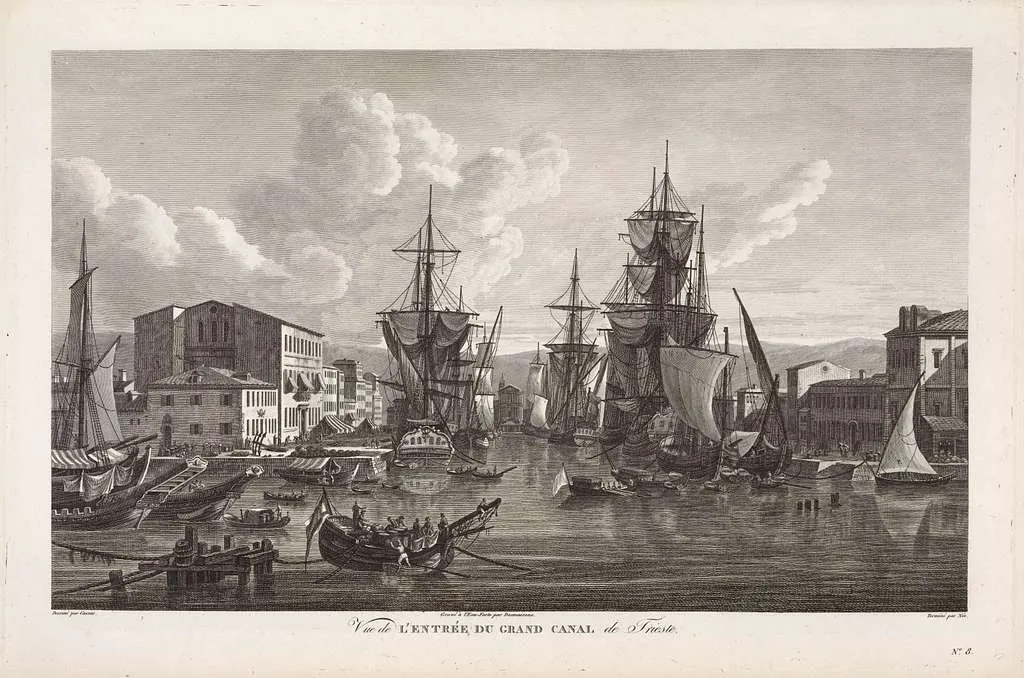
The decisive break is 1719, the year in which Emperor Charles VI established the free port of Trieste. The privilege transformed a sleepy Habsburg outpost of about 5,700 inhabitants into a cosmopolitan free trade hub. Over the following decades, immigrants from across the Empire and the Mediterranean — Germans, Slovenes, Greeks, Armenians, Jews, Venetians, Friulians, Dalmatians — converged on the new Borgo Teresiano, the planned mercantile district north of the medieval city.
Demographic explosion and linguistic substitution
Trieste's population grew dramatically:
- 1719: about 5,700 inhabitants
- 1815: about 33,000
- 1880: 144,844
- 1910: 229,510
The lingua franca of Adriatic trade was the Venetian dialect, already used in Istria, Dalmatia and the Eastern Mediterranean. Within two generations the new mercantile bourgeoisie spoke Venetian — and the old urban tergestino retreated to working-class neighbourhoods, to peasant villages around the city, to the antique families of the historic centre.
A diglossic city
Linguists describe what happened with a single sentence:
"A phase begins, characterised first by the resistance of the original speech (until the end of the eighteenth century) and then by its rapid collapse (the first decades of the nineteenth century)."
By 1750 the bourgeoisie spoke Venetian-Triestine. By 1810 even the artisans of the Città Vecchia had abandoned the tergestino. By 1850 only a handful of elderly speakers, mostly in the tredici antiche casate — the thirteen ancient patrician houses — still maintained it as a secret family idiom.
Lis tredis ciasadis — the last keepers of the language
In the early nineteenth century, the tergestino survived almost exclusively among the 'lis tredis ciasadis' — the thirteen households, the ancient Triestine patrician families. The very expression — thirteen (tredis), households (ciasadis) — is in perfect Friulian-Rhaeto-Romance phonetics, not Venetian. These families transmitted the language to their children as a jealous identitary patrimony, while the city around them spoke an increasingly triestinised Venetian.
Surviving texts
Because the tergestino was overwhelmingly oral, the corpus that has reached us is fragmentary but precious:
- circa 1689 — fragment of an anonymous satirical poem
- 1796 — Sonet del ver Triestin, signed 'G.M.B.', composed for the consecration of a bishop
- 1796 — Il Racont, anonymous verses on the same occasion
- 1828 — Dialoghi piacevoli in dialetto vernacolo triestino by Giuseppe Mainati, sacristan and choral vicar of the Cathedral of San Giusto, published in Trieste by G. Marenigh — the most extensive source we have
- 1835-1841 — Paràbula del fi prodigh (Parable of the Prodigal Son), again by Mainati
The voice of Mainati
An extract from the Parable of the Prodigal Son in Mainati's transcription:
"Un òmis l'hau bù dò fiòi. El fi plùi zòuem um di el ghàu dit a sòu pare: missiòr pare uòi che me dèi la mèja part de l'eredità che me uèm…"
'A man had two sons. The younger one day said to his father: my lord father, I want you to give me the part of the inheritance that is mine…'
The reader can almost hear the Friulian-style -s plurals, the open vowels, the rhythm of a Rhaeto-Romance language at the moment of its disappearance.
The scholars who rescued the tergestino
Graziadio Isaia Ascoli (1829-1907)
The father of Italian glottology, Graziadio Isaia Ascoli, coined the term tergestino in his Saggi Ladini of 1873, identifying it as one of two south-eastern Rhaeto-Romance varieties — together with the muglisano. Ascoli relied largely on Mainati's Dialoghi as primary source. His thesis met fierce scepticism in local Triestine circles, but he defended the authenticity of Mainati's texts against those who claimed they were eighteenth-century forgeries.
Jacopo Cavalli (1893)
In 1889 and 1890 the Triestine scholar Jacopo Cavalli travelled to Muggia twice and interviewed the last elderly speakers who still remembered the muglisano dialect. He collected proverbs, stories, vocabulary. His Reliquie ladine raccolte in Muggia d'Istria, con appendice sul dialetto tergestino was published in Trieste by G. Caprin in 1893 — both in the Archivio Glottologico Italiano (vol. XII) and in the Archeografo Triestino. The appendix on the tergestino remains a fundamental document.
Pietro Kandler, Pier Gabriele Goidanich, Mario Doria
- Pietro Kandler, initially sceptical, eventually accepted the existence of two superimposed idioms in medieval Trieste: a plebeian tergestino and a Venetian-influenced register of mercantile elites
- Pier Gabriele Goidanich (1903) systematised the historical bipartition into two phases
- Mario Doria, between the 1960s and 1990s, produced the critical edition of Mainati's Dialoghi (Italo Svevo editore, Trieste 1972) and demonstrated that approximately 60% of Triestine place names are of tergestine origin — a hidden linguistic heritage still visible on every map of the city
A vocabulary of disappearance
Thanks to these scholarly collections, we know a small but evocative corpus of tergestine words and expressions:
| Tergestino | English |
|---|---|
| Ze fastu? | What are you doing? |
| Ze astu fat? | What have you done? |
| La fèmina | The woman |
| El ciaf | The head |
| La ciaudiera | The cauldron |
| Braida | Vineyard / enclosed garden |
| Lait a ciasa, che l'mamul plora | Go home, the child is crying |
And a popular nursery rhyme that survived as late as the twentieth century:
La tecia clocene / Ciapa caciul e mlecene
'The pot is boiling / Take the spoon and stir'
The buried map: tergestino place names
When we walk through the streets of Trieste we are constantly walking on tergestino. According to Mario Doria, approximately 60% of Triestine place names have a Rhaeto-Romance origin — Friulian-tergestine in phonetics and morphology:
- Barcola, Roiano, Servola
- Chiarbola, Chiadino, Pondares, Baudariu, Cologna, Gretta, Sant'Anna
- Braida, Banne, Conconello, Padriciano, Trebiciano
Most modern Triestines use these names every day without realising they come from a language that vanished from the streets two centuries ago.
The poetic resurrection: Ivan Crico (2008)
The most surprising chapter of the tergestino's afterlife is its literary revival in our own time. In September 2008 the painter and poet Ivan Crico (b. Gorizia 1968) published with the Istituto Giuliano di Storia, Cultura e Documentazione the collection De arzènt zù ('Of Vanished Silver'), composed in a reconstructed tergestino drawn from Mainati's Dialoghi. In 2009 the work received the prestigious Premio Biagio Marin for dialect poetry — the highest Italian recognition for minority linguistic poetry.
A language we can still hear
The tergestino is extinct as a spoken idiom. No one in Trieste today uses biel, fèmina, ciaudiera in daily conversation. And yet it would be wrong to call it dead. Every time we say Chiarbola or Roiano, every time we glance at the Triestine dialect today and notice an unexpected -s in ze fastu, every time we open Mainati's Dialoghi and see the acuti over the vowels, we are touching the memory of a language that for more than a millennium was Trieste.
Beneath the Venetian surface of modern Triestino, the tergestino still murmurs in the foundations — in the place names, in the family memories of the tredis ciasadis, in the poems of Ivan Crico. It is the first, forgotten voice of the city under San Giusto.