Trieste's Forgotten Industries: Vanished Factories of the Habsburg City
From the secret Veneziani paint managed by Italo Svevo to the Alba automobile that lasted two years, from Barcola's crystal ice to the English biscuits of Barriera Vecchia: a journey through the vanished industries of Habsburg Trieste.
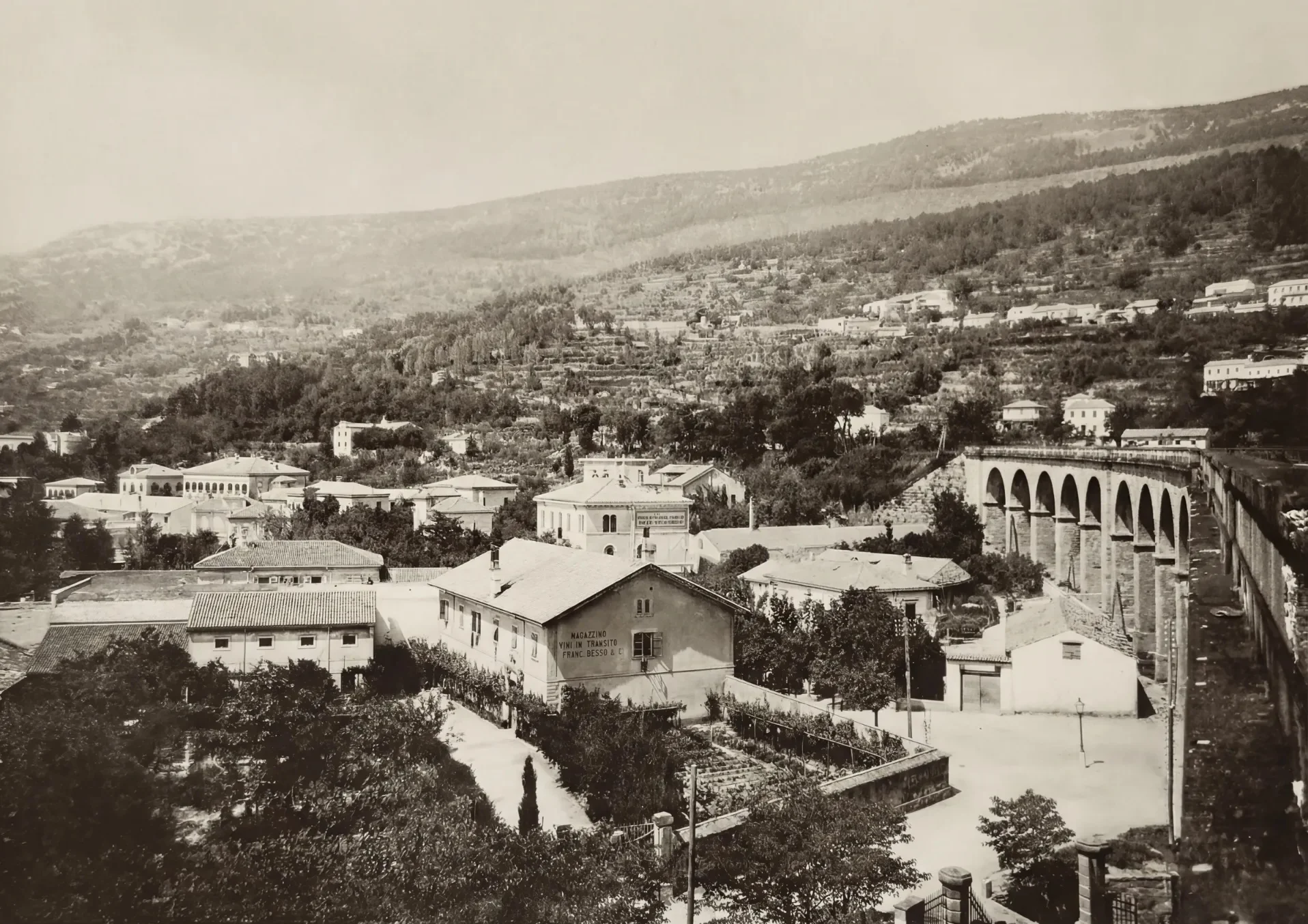
When we speak of Habsburg Trieste, we picture historic cafés, insurance palaces and the bustle of the harbour. Yet the forgotten industries of Trieste tell another story: a city of smoking chimneys, secret formulas and bold ventures, where a writer ran a paint factory and a group of bourgeois enthusiasts dreamed of building automobiles. Let us walk through the vanished factories of the Habsburg city, following the traces they left in street names, in literature and in red-brick walls.
An Industrial Ecosystem in the Shadow of the Port
Trieste's industrial and port histories are often told separately, but one was the consequence of the other. The free port established under Maria Theresa did not merely store goods: it processed them. The growth of shipping created enormous demand for rope, industrial oils, underwater paints, soaps and precision instruments — everything a fleet needed (Source: TRIESTE.news).
The numbers are striking. In 1920 the province of Trieste hosted some 13,000 industries with fewer than twenty workers each, a galaxy of micro-enterprises employing around 30,000 workers overall. Shipyards such as the Lloyd Arsenal anchored this ecosystem, but around them flourished hundreds of workshops that history books rarely mention. The collapse of the Austro-Hungarian Empire and the crisis of 1929 would cut this fabric apart, severing Trieste from its Central European hinterland.
The Veneziani Factory: A Secret Formula and Svevo's Conscience
In 1863 Giuseppe Moravia invented an anti-fouling paint for ship hulls, the Moravia paint, whose formula remained secret for decades. The management of the business passed to his daughter Olga Moravia and her husband Gioachino Veneziani, who gave his name to the firm on the road to Servola — today via Svevo (Source: Wikipedia, Brain_Storia).
The secrecy was legendary: when the key ingredients went into the boiler, workers left the room and only family members proceeded. It is said that Olga preferred to hire workers who were not too curious, the better to protect the recipe. The product conquered the world's navies: every hull of the Austrian Lloyd was treated with Veneziani paint, and the navies of Italy, Austria, Great Britain, the USA, Russia, Turkey, Greece and Argentina adopted it.
In 1899 the writer Italo Svevo — Ettore Schmitz, who had married Livia Veneziani — joined the firm as a manager. In 1903 he organised the opening of a branch in Charlton, near London, to supply the British Admiralty. It was precisely to polish his business English that Svevo took lessons from a young Irish teacher then living in Trieste: James Joyce, whose admiration for La coscienza di Zeno would later launch Svevo's literary fame in France. During the First World War the factory was requisitioned and its machinery moved to Pola; the family villa next door was destroyed by bombing in February 1945.
Alba: The Triestine Automobile That Lasted Two Years
In 1906 a group of automobile enthusiasts from prominent Triestine families founded the Alba Fabbrica Automobili S.A. — in German Alba Automobilwerke Aktiengesellschaft. Among them were Ettore Modiano, son of the founder of the famous paper-products firm, Edmondo Richetti of Assicurazioni Generali, and the Romanian consul Nicolò Sevastopulo (Source: Wikipedia, atrieste.eu forum).
The factory, designed by the Berlam studio, occupied a 20,000-square-metre shed in the San Sabba/Valmaura area and employed about 150 workers under engineer Bauer. For the 1907 Paris Motor Show the firm prepared its most powerful model, the 35/40 HP, with a four-cylinder 6,868 cc engine, shaft drive and a four-speed gearbox. The critics applauded its modern engineering.
Applause, however, does not pay wages. In 1908 only nine or ten cars were built — far too few for such a workforce — and the company went into liquidation between July 1908 and 1909. One of the few cars produced, registered K1296, was bought by the City of Trieste for its fire brigade: a poignant end for the city's only automobile factory.
Industrial Cold: The Crystal Ice Factory of Barcola
Before household refrigerators, ice was an industrial product. In 1894 Cavaliere Enrico Ritter de Zahòny founded a crystal ice factory in Barcola, near the small harbour of Cedas, employing up to eighty workers — a substantial enterprise for a village that until the mid-nineteenth century had been home to about 400 fishermen (Source: Trieste di ieri e di oggi).
The site has a remarkable archaeological twist: in 1887, during excavations for a canal along the boundary of the factory grounds, workers uncovered mosaics belonging to a vast Roman villa of the first to second century BC. The factory grounds were later occupied by the Fiat dealership of Antonio Grandi. Today nothing remains of the industrial cold of Barcola but documents and photographs.
Biscuits, Wood and Cigarette Papers: The Minor Vanished Industries
Beyond the famous names, a constellation of smaller factories made Habsburg Trieste hum:
- London Biscuit Factory A. Gatti (c. 1890): founded with English capital between Montebello and Barriera Vecchia, it produced British-style quality biscuits for the Levant and Anglo-Saxon markets, with five 300-kilo kneading machines and a pioneering assembly line praised for its hygiene.
- G. Cante woodworking factory (1848): founded by Carlo Cante, moved in 1892 to Corsia Stadion (today via Battisti) with 150–200 workers. After visiting the 1900 Paris Exposition, Giovanni Cante invented the wooden shopfront with rolling iron shutters that still defines Trieste's historic shops, and crafted the massive counter of Caffè San Marco in 1913.
- A. Salto cigarette-paper works (1888): from via Ireneo della Croce to the modern plant in via Media, where 120 women worked on the first floor alone. Each machine had its own motor — a safety innovation that eliminated the dangerous transmission belts.
- The Shot Tower (1839): built by Giuseppe Ciana on the family factory founded in 1806 by Dioniggi Ciana, it produced lead hunting shot by free fall. According to historian Diego de Henriquez it is the oldest industrial structure in Trieste, sketched even by William Turner in 1840.
What Remains: Industrial Archaeology between Dreher, Stock and Holt
Some giants left visible traces. The Dreher brewery rose in via Giulia in just 230 days, inaugurated on 15 January 1866 by a consortium of Trieste's elite — Morpurgo, Revoltella, the Rothschild bank. Anton Dreher equipped it in 1877 with a revolutionary refrigeration compressor, now in Vienna's Technical Museum. Closed in 1976 and largely demolished in 1986, it survives as a single neo-Gothic building at via Giulia 75.
The Stock distillery, founded on 26 December 1884 in Barcola by the eighteen-year-old Lionello Stock with 2,000 florins borrowed from his father, moved in the 1920s to Roiano, where the red-brick Stock town still stands, recovered since 1993. The Holt workshops in via Gambini, founded by Thomas Holt of Manchester who arrived in 1840, survive with their crenellated façades, converted into apartments.
A Memory to Rediscover
The forgotten industries of Trieste were not a footnote: they shaped neighbourhoods, street names and even literature. Without the Veneziani factory, Svevo might never have met Joyce; without the workshops of Barriera Vecchia, entire districts would look different. Walking today through Servola, Barcola or Roiano means crossing an invisible industrial map — a city of work and ambition that deserves to be remembered alongside its cafés and palaces.