The Bonapartes in Exile in Trieste: Napoleon's Secret Courts in Metternich's City
After Napoleon's fall, his brothers and sisters chose Habsburg Trieste as a refuge: Elisa Baciocchi, Caroline Murat and Jérôme Bonaparte lived here under false names and the close watch of the Austrian police.
Bonapartes, exile, Trieste. Three words that hide one of the most curious chapters in the history of the Habsburg city. After the abdication of Napoleon on 6 April 1814, the imperial family scattered across Europe in search of refuge — and a surprising number of them chose Trieste, the great free port of the Austrian Empire, only a few years after the Napoleonic occupation of the very same city had ended.
Why Habsburg Trieste
For about a decade, Trieste hosted two small courts in exile. The choice was paradoxical: the relatives of the man who had bent Europe to his will now sought protection from his fiercest enemy, the Habsburg monarchy. Trieste offered a cosmopolitan, multilingual society, a mild climate, and the discretion of a busy port where many languages and many pasts could blur together. In exchange, the Bonapartes had to renounce all political ambition and accept the constant attention of the imperial authorities.
In the shadow of Metternich
The exile was never truly free. Chancellor Klemens von Metternich and the Austrian police kept the refugees under tight surveillance, suspicious of plots and of escapes by sea from such a strategic maritime city. To rebuild a life without the weight of a dangerous surname, the Napoleonids hid behind invented titles:
- Elisa Bonaparte Baciocchi became the Countess of Compignano;
- Jérôme Bonaparte arrived first as Count de Harz, then used the title Prince of Montfort;
- Caroline Murat chose Countess of Lipona — a melancholy anagram of Napoli, the kingdom she had lost.
Elisa Baciocchi: the grand duchess of Villa di Campo Marzio
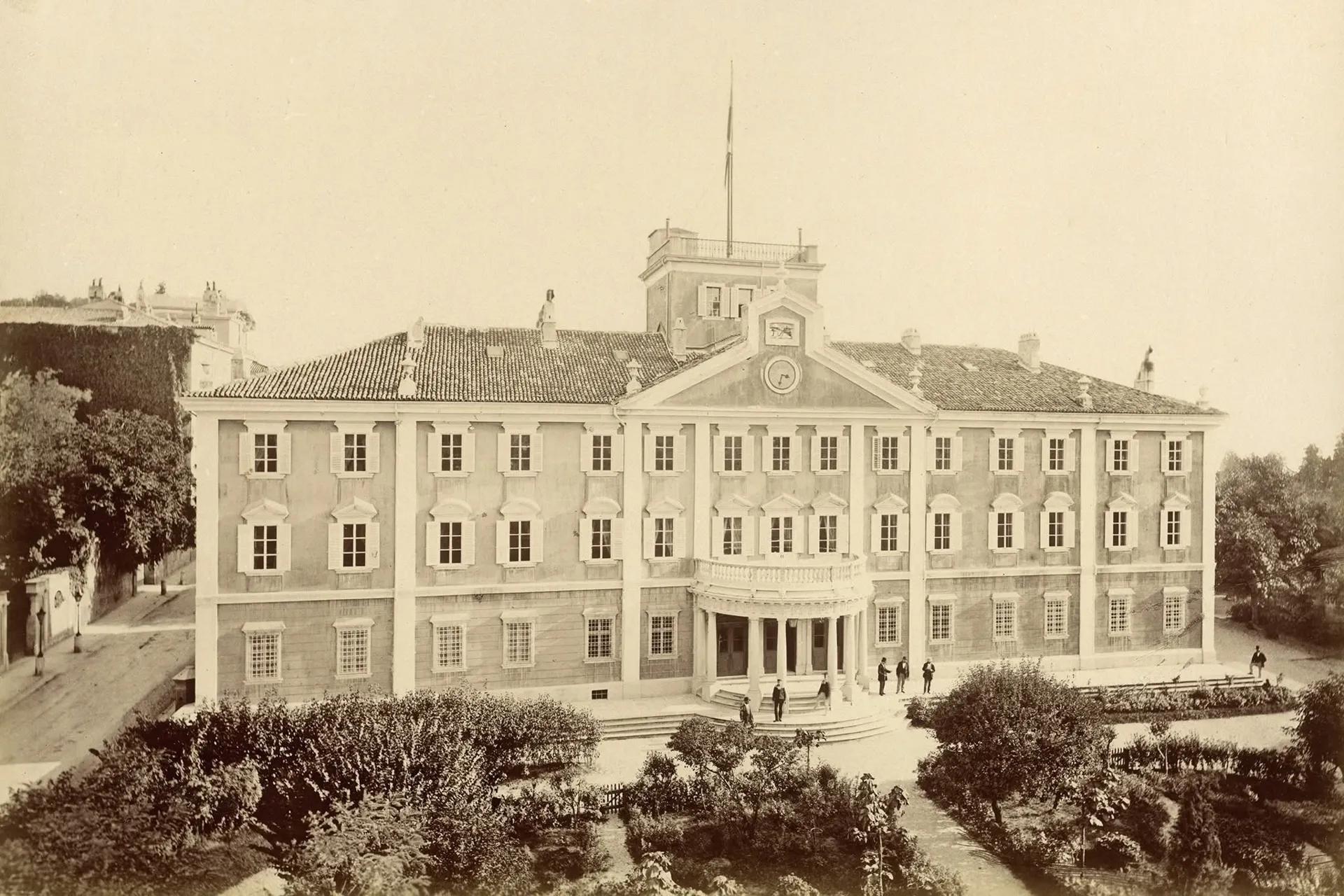
Elisa, former Grand Duchess of Tuscany, reached Trieste on the night of 6–7 August 1814 and settled permanently in 1816, when she and her husband Felice Baciocchi bought the neoclassical Villa di Campo Marzio on the hill of Sant'Andrea from the Russian general Psarò. Though she was effectively under house arrest, Elisa never gave up luxury: gilded furniture, alabaster sculptures, paintings, and secret visits — disguised behind extravagant masks — to the Teatro Nuovo (today the Teatro Verdi). Her home became a salon for intellectuals such as Domenico Rossetti, with concerts by the Società di Minerva. In 1820, struck by a serious illness, she withdrew to her estate at Villa Vicentina, where she died on 7 August at only 43.
Jérôme Bonaparte: escapes, scandals and Villa Necker
Jérôme, former King of Westphalia and Napoleon's youngest brother, first lodged at the Locanda Grande in Piazza Grande (today Piazza dell'Unità). On 26 March 1815 he tricked the Austrian guards and fled the city on a fishing boat to join his brother during the Hundred Days, fighting at Waterloo. Back in exile, he lived at Villa Necker, where on 9 September 1822 his son Joseph Napoleon Charles Bonaparte — nicknamed Plon Plon — was born. That child would marry Clotilde of Savoy and seal the Franco-Piedmontese alliance of 1859. Metternich's patience ran out: on 26 March 1823 Jérôme was forced to leave Trieste for Rome.
Caroline Murat, Countess of Lipona
Caroline, widow of Joachim Murat — shot at Pizzo Calabro in October 1815 — reached Trieste from Venice as early as 6 June 1815, was then interned near Vienna, and only after Napoleon's death returned to settle, from 1823, in her sister's villa, which she renamed Villa Murat. Unlike Elisa's lively court, Caroline lived in solitude among books and painting until she moved to Florence in 1830, dying there in 1839.
What remains today
Villa Murat was demolished in 1899 to make room for the expansion of a rice mill; only the terrace of Passeggio Sant'Andrea survives, with its view over the gulf. The bust of Felice Baciocchi by Bartolini is preserved at the Museo Revoltella. The most tangible memory is Villa Necker, where a commemorative plaque still recalls the birth of Prince Napoleon "Plon Plon" — a discreet trace of the years when Habsburg Trieste was the secret, melancholy stage for the epilogue of the Napoleonic dynasty.