History of public transport in Trieste: from omnibus to electric tram
From the first horse-drawn omnibus of 1860 to the last run of tram number 9 in 1970: over a century of public transport in Trieste, through horse trams, electrification, trolleybuses and buses.
There was a time when crossing Trieste meant climbing aboard a horse-drawn carriage, paying a few soldi and hoping the cobblestones would be merciful. The history of public transport in Trieste is a story of pioneering spirit: the city had its horse tram one year after Paris and ahead of Rome, Bologna and Milan, and welcomed the electric tram four years before Bologna. Let us retrace more than a century of urban mobility, from the omnibus of 1860 to the very last tram in 1970.
From omnibus to horse tram: the beginnings (1860-1899)
The first form of public transport appeared in 1860: carriages that were closed in winter (called omnibus) and open in summer (the so-called giardiniere), run by private operators. The very first route linked the Public Garden to the Österreicher bathing establishment at the end of via del Lazzaretto Vecchio. A ride cost four to five soldi, far cheaper than a private cab. Among the operators, the firm Cimadori & Vitturelli dominated the scene with its elegant eight-seat carriages.
As the city grew — 125,000 inhabitants by 1875 — the demand for rail-based transport grew with it. After years of debate, the first horse-drawn tram line was inaugurated at dawn on 30 March 1876, between the Boschetto and Palazzo Rittmeyer. Trieste came one year after Paris, one year before Rome and Bologna, and six years before Milan.
The operator was the Società Triestina Tramway (STT), a company with Belgian capital, also known as Triester Tramway Gesellschaft and Société de Tramways de Trieste. Its carriages had two classes — first class at ten soldi, second at five — ran every fifteen minutes and had no fixed stops: passengers simply waved at the driver. By 1900, the year of maximum expansion of the horse-drawn network, the lines reached:
- Barcola, along the seafront to the north-west
- Barriera Vecchia and piazza Giuseppina (today piazza Venezia)
- the Punto Franco and the Bagno Fontana
- the two railway stations, Südbahnhof and Sant'Andrea
In summer the open carriages, shielded by canvas sheets when it rained, reminded the Triestines of warships: they nicknamed them torpediniere, torpedo boats.
The electric revolution (1900)
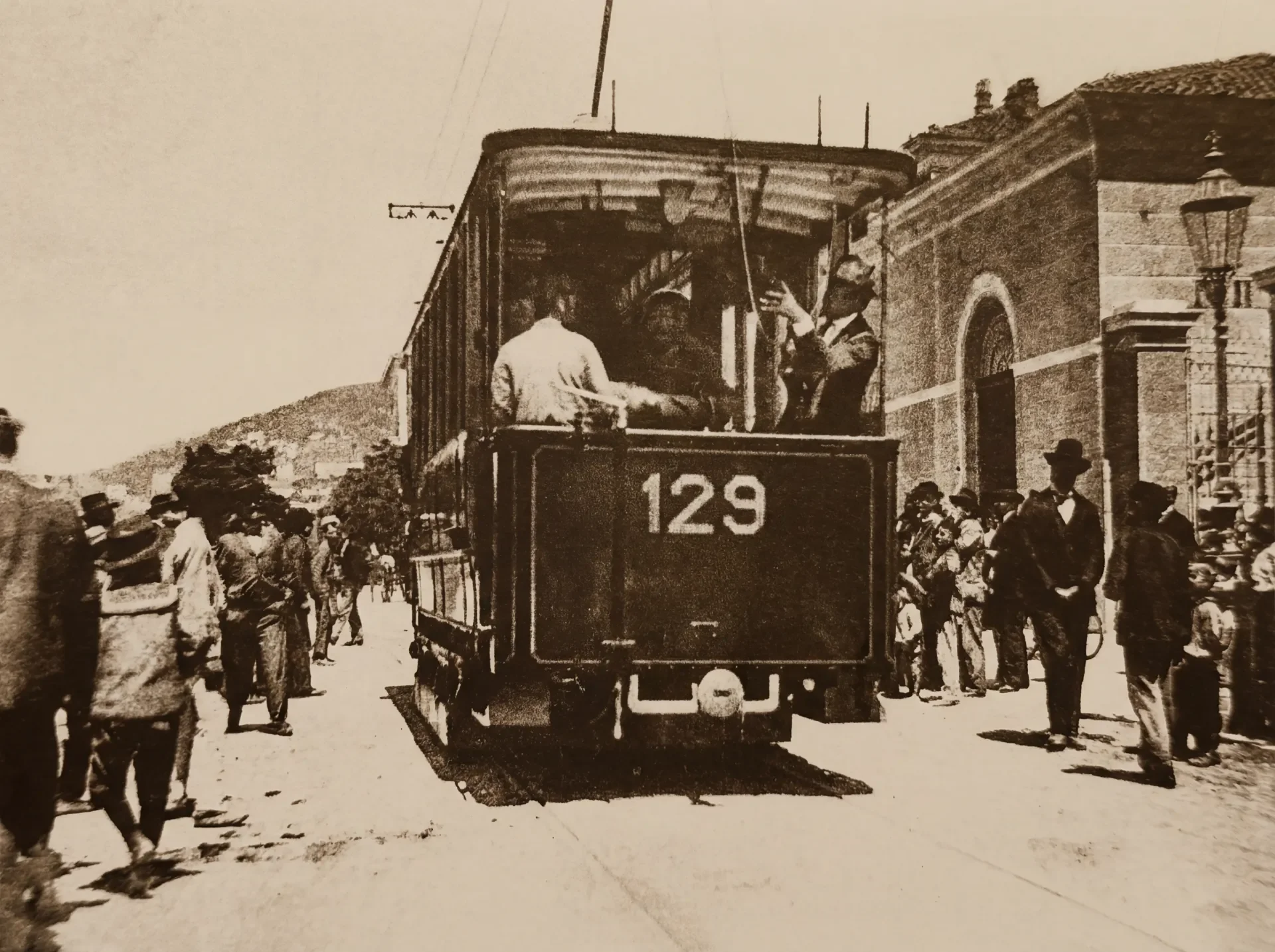
On the evening of 3 October 1900, at six o'clock, the STT inaugurated the first electrified line, from the Boschetto to Barcola. The timing was a marketing masterstroke: the brightly lit carriages dazzled the crowd in the autumn dusk. At 6.15 pm three convoys left the brand-new depot in via Margherita and reached Barcola in twenty-eight minutes, passing along Corsia Stadion (today via Battisti) and via del Torrente (today via Carducci). Among the dignitaries were Filippo Artelli, president of the STT, and the engineer Wigny, director of works.
The service was operated by sixty new motor cars built by the Union company of Vienna, painted olive green and cream. The network ran on standard tramway gauge (1,445 mm) at 600 volts direct current. The old horse-drawn carriages did not disappear: many were converted into trailers for the new electric trams. In 1902 the celebrated Opicina tramway also opened — an engineering feat designed to climb the Karst plateau, which deserves a story of its own.
The municipality enters the field: the "Graz" line and the Great War
The early twentieth century brought a fierce political battle. The socialist opposition denounced the privileges of the private STT and demanded municipalisation. The city council decided to build and run its own lines; the STT sued, and the case dragged on until 19 May 1910, when the supreme court of justice in Vienna ruled in favour of the Municipality.
On 7 June 1913 the first municipal line, from piazza Goldoni to San Sabba, entered service. It was built by the German AEG and used twelve luxurious red, gold and ivory cars of the "Graz" type, made by the Grazer Waggonfabrik — reportedly the first trams with electric heating, originally ordered by Saint Petersburg, which never collected them. That same year the last horse-drawn tram, on the Punto Franco line, was retired.
The First World War brought everything to a halt. On 23 May 1915 the military authorities requisitioned the copper overhead wires; the city temporarily went back to horse traction, and later to iron wires that showered the streets with sparks.
The public era: Municipal Tramways, ACEGAT and the arrival of rubber
On 1 January 1921, after redeeming the network from the STT, the Municipality created the Azienda Comunale Tranvie Municipali. The 1920s were years of modernisation: fifty-two new motor cars arrived from the Italian builders Bagnara, Savigliano and Casaralta, alongside the twelve "Graz" cars.
In 1934 all municipal utilities were merged into a single company, ACEGAT (electricity, gas, water and tramways). It was also the last year in which public transport closed its books in profit. New technologies arrived on the steepest routes: the first diesel bus line in 1934, and on 30 March 1935 the first trolleybus line, number 12, the Linea dei Colli, from piazza Goldoni to Campo Marzio across the San Vito hill. The trolleybus was quieter, nimbler on gradients and — crucially, in the autarchic climate of the Fascist regime — ran on electricity rather than imported diesel. In 1936 the tram network still measured 41.7 km, against 19.8 km of bus routes and 3.1 km of trolleybus lines.
The Second World War hit the system hard: blackout headlights with white stripes (baffi, "moustaches") painted on the tram fronts, women and elderly men replacing conscripted staff, and devastating air raids in 1944-1945 that destroyed the central workshops of Broletto.
The twilight of the rails (1946-1975)
Reconstruction, initially supported by the Allied Military Government, was followed by a golden age of the trolleybus: in 1952 the interurban line 20 to Muggia opened, serving the new industrial zone of Zaule. But the rise of the private car and the spread of new suburbs condemned the rigid tram network. Line 3 closed in 1966, line 8 in 1968, line 6 on 30 December 1969.
On 31 March 1970, at 9.05 pm, tram number 9 from Campi Elisi to San Giovanni made the last urban tram run in Trieste's history. The trolleybuses survived only five more years: on 12 April 1975 line 19, from the Central Station to piazzale Umberto Cagni, was suspended, ending electric road traction in the city.
The legacy
In 1977 the transport assets of ACEGAT merged into the Azienda Consorziale Trasporti (ACT), whose activities passed in 2001 to today's Trieste Trasporti. Of the entire rail network, only the Opicina tramway survives — a living monument to the era when Trieste pioneered public transport. Looking at the buses climbing the city's hills today, it is worth remembering that this story began with eight-seat carriages, two horses and a bell.