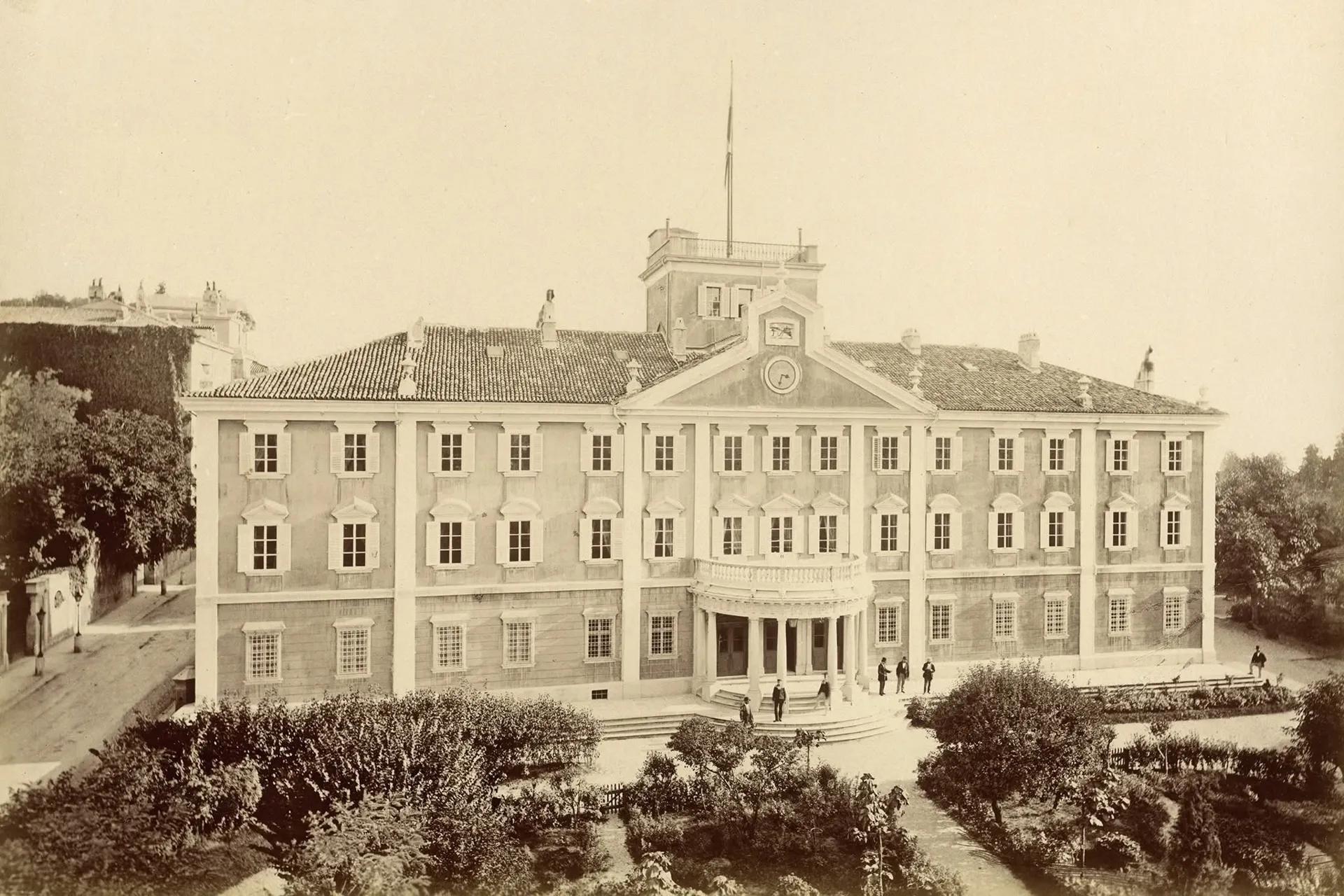
The Suburban Villas of Trieste: The Bourgeoisie Beyond the City
On the hills and along the coast of Trieste, merchants, shipowners and Habsburg aristocrats built villas, parks and greenhouses. A journey through the residences that tell the rise of the nineteenth-century bourgeoisie.
When, in 1719, Emperor Charles VI granted Trieste the status of a free port, he set in motion a transformation that within a century turned a marginal town into one of the great commercial metropolises of the Habsburg Empire. The new wealth needed a stage, and that stage was the suburban villa: residences built on the hills and along the coast where merchants, shipowners and aristocrats could display their success far from the bustle of the harbour.
The free port and the rise of the Trieste bourgeoisie
Over the course of the eighteenth century Trieste's population grew from roughly 5,000 to 30,000 inhabitants. The old patriciate vanished and, as historian Giorgio Apih observed, "the new Trieste was born as the most bourgeois city of Austria." This was a cosmopolitan society of traders, insurers and bankers who, having made their fortune in the counting houses near the port, sought to affirm their status through lavish residences of representation.
Unlike older Italian cities, Trieste had no inherited artistic tradition. Its architects were foreigners — the German Pertsch, the Venetian Selva — and so were its painters and sculptors. The villa became the canvas on which this self-made class wrote its identity.
The hills and the coast as places of leisure
The southern slopes of the Scorcola hill, the Farneto (formerly the "Cacciatore" hill) and the district of San Vito offered something the crowded city could not: panoramic views over the Gulf. After the new road to Opicina was inaugurated in 1830, elite families built splendid villas surrounded by parks, gardens and great greenhouses for floriculture. Along the coast, towards Barcola, other residences turned their gaze to the sea.
- Scorcola: the eclectic Castelletto Geiringer
- Farneto / Cacciatore: the Revoltella estate and the Ferdinandeo
- San Vito: Villa Lazarovich, with its Moorish turret
- Gretta and Barcola: the Cosulich villa and the Russian House
The Napoleonids in exile
Few people remember that Trieste was a refuge for the Bonaparte family after Napoleon's fall. Carolina Bonaparte, sister of the Emperor and former Queen of Naples, arrived on 6 June 1815 under the name "Countess of Lipona" and eventually settled in the villa that bore her married name, Murat (now demolished).
At Villa Necker, given its definitive form in 1748 by the French architect Champion, the high society of Europe gathered in the first half of the century. Here, in 1822, was born Joseph Napoleon Charles Bonaparte, nicknamed "Plon Plon," who would later marry Clotilde of Savoy and play a role in the Risorgimento.
The architects of the suburban landscape
The dominant figure was Friedrich Hitzig, a Berlin architect and pupil of Schinkel, who designed both the city palace and the summer villa of Pasquale Revoltella in an elegant neo-Renaissance style. A generation later, the engineer-architect Eugenio Geiringer (1844–1904) reshaped a country house on Scorcola into a neo-medieval "little castle," complete with merlons and twin towers, while also designing the Opicina tramway inaugurated in 1902. Other interpreters — Antonio Buttazzoni, Feliciano Vittori — translated neoclassical and "neo-castle" tastes into stone.
Nature and artifice: parks, greenhouses and botany
The garden was as important as the house. At Villa Lazarovich, Archduke Maximilian of Habsburg lived from February 1852, cultivating exotic plants before building the Castle of Miramare. Geiringer planted a famous camellia grove for his wife Ortensia, while Revoltella's greenhouses on the Cacciatore hill grew pineapples for his sumptuous banquets. Italian-style parterres, English landscape parks and vineyards completed the picture of an aristocracy of taste.
The great dynasties and their residences
Each villa is also the portrait of a family.
- Villa Revoltella belonged to the baron and patron Pasquale Revoltella (1795–1869), financier of the Suez Canal, ennobled by Franz Joseph in 1867.
- Villa Sartorio was the home of a merchant dynasty from Sanremo.
- Villa Cosulich passed in 1920 to a great shipowning family with interests in Argentina.
- Villa Economo hosted, from 1883, the explorer Sir Richard Francis Burton, who there translated the Arabian Nights and the Kama Sutra.
From private to public: the twentieth-century destiny
Many of these villas became gifts to the city. Revoltella's palace became, in 1872, the first public gallery of modern art in Italy; Villa Sartorio opened as a civic museum in 1954. Others were converted: Villa Geiringer now houses the European School of Trieste. And some, like Villa Cosulich, fell into decay, reminders that the splendour of the Habsburg bourgeoisie was, like the free port that created it, a chapter that eventually closed.