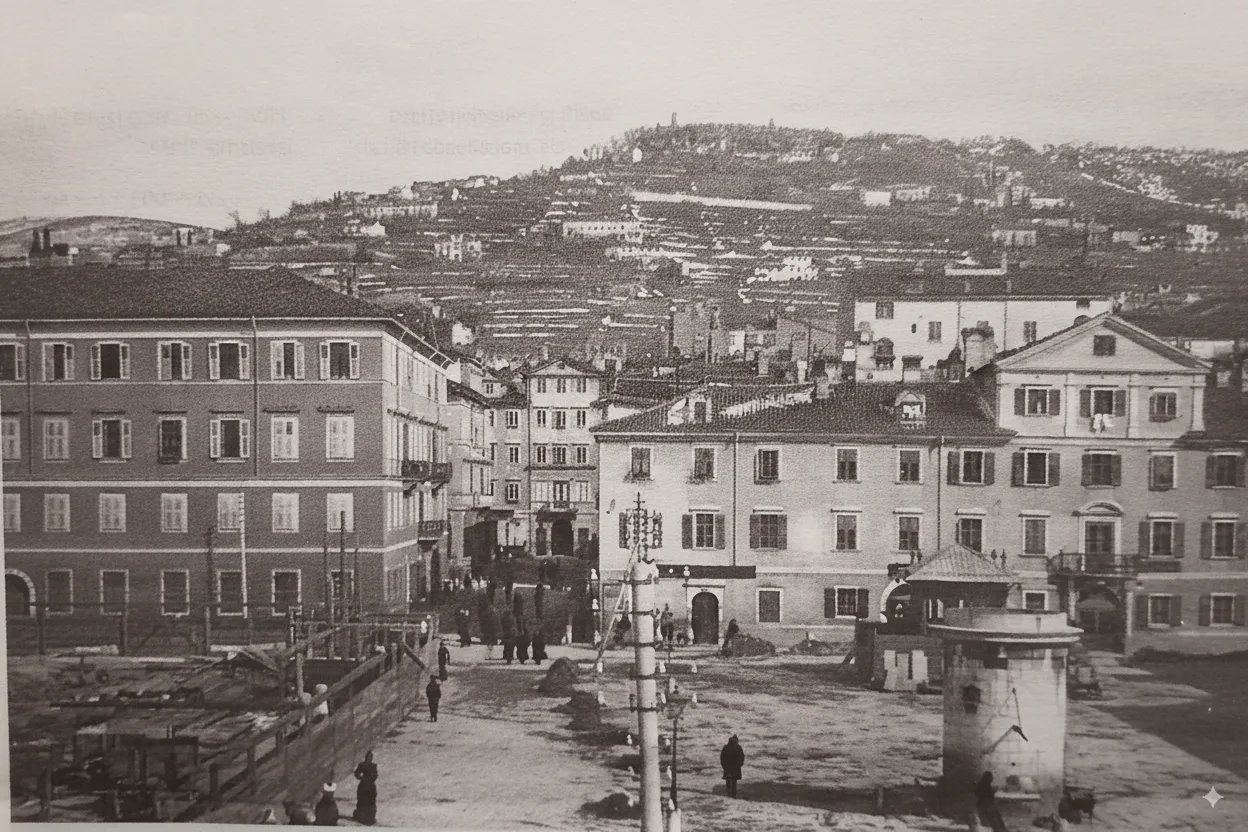
Piazza Vittorio Veneto is one of the most significant historical squares in Trieste, located in the Borgo Teresiano district, near the central railway station (Stazione Centrale) and close to Piazza Oberdan.
Origins in the 18th century
The square was created in the 18th century as part of the urban expansion that gave rise to the Borgo Teresiano. Originally called Piazza della Dogana (Customs Square), after the Austro-Hungarian customs house that stood there, it reflected the city's strategic and administrative role under the Habsburg Empire.
Main late-19th-century buildings
Between 1890 and 1894, once the customs house had been relocated, the old building was demolished and replaced by the majestic Post Office Palace, an imposing Viennese-style building that housed — and still houses — postal, telegraph and financial offices.
At the same time, on the opposite side of the square, the Railway Palace was erected, designed by the engineer Raimondo Sagors and completed in 1895; for decades it served as the seat of both the Austro-Hungarian and Italian railway administrations.
The Fountain of the Tritons
At the centre of the square stands the famous Fountain of the Tritons, built together with the great late-19th-century palaces. Its construction also served the curious purpose of occupying the central space and preventing the erection of a monument dedicated to Emperor Franz Joseph of Austria.
The 1919 change of name
In 1919, at the end of the First World War, the square took its present name in memory of the Battle of Vittorio Veneto, the event that marked the end of Austro-Hungarian rule over the city and a shift in Trieste's political identity.
Historical functions of the Railway Palace
Over time, the Railway Palace has served many functions:
- Seat of the railway administrations
- Foreign consulates (Argentina, Norway, Portugal)
- Shipping and forwarding companies
- After-work recreational associations
- First-aid post of the Italian Red Cross
- A theatre (the Teatro del Dopolavoro Ferroviario), later converted into the Cinema Vittorio Veneto in 1949
Contemporary redevelopment
Between 2000 and 2005 the square was redeveloped by the Italian-Slovenian architect Boris Podrecca, who also introduced an underground car park while respecting the historical character and preserving the harmony of the space.
The square is a perfect example of Viennese-style architecture in Trieste, a witness to the historical and cultural layering of the city, where the Austrian and Italian legacies coexist in an urban setting rich in meaning.