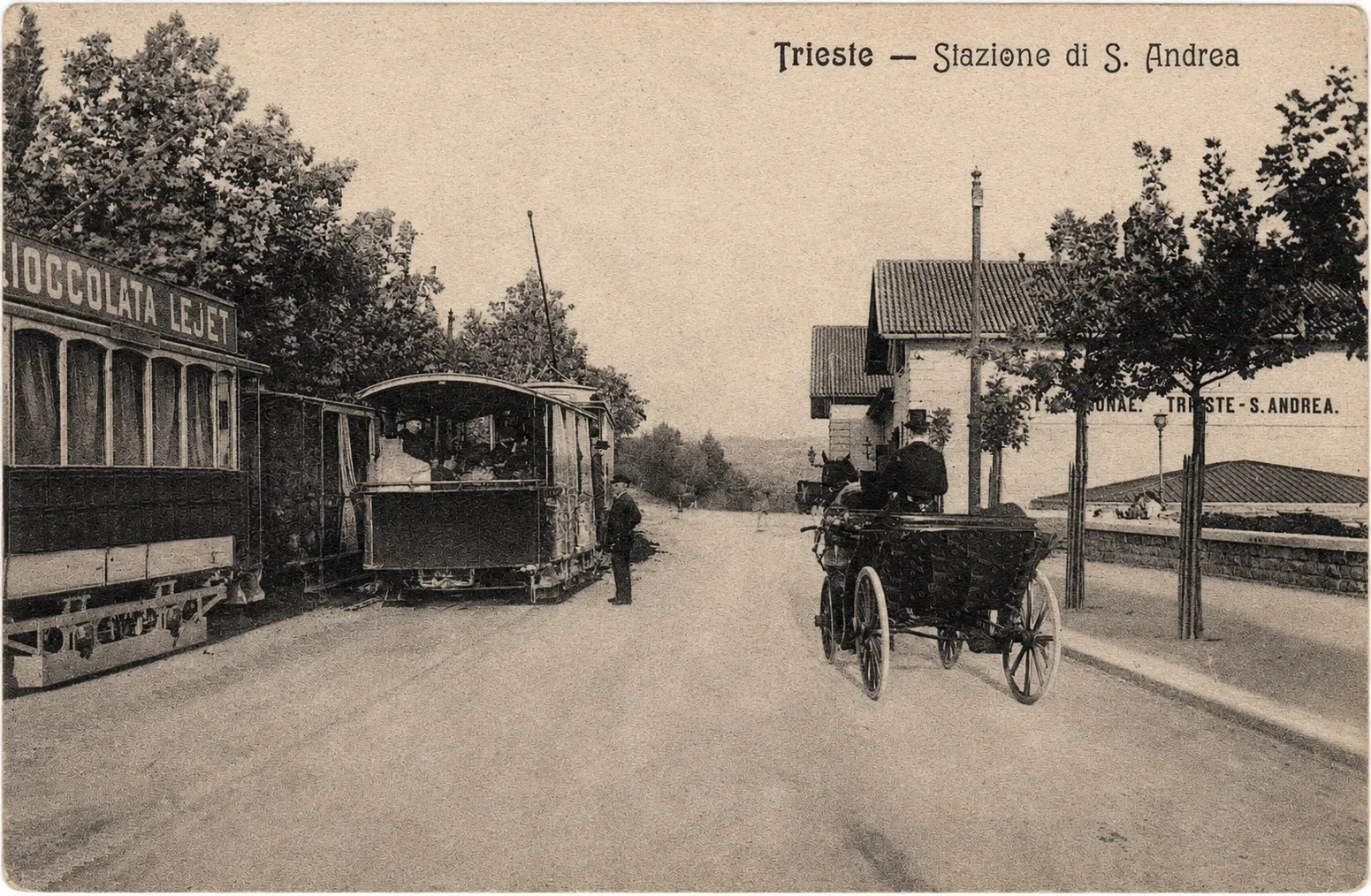
Trieste Sant'Andrea Station was the first station of the Austrian State Railways (k.k. Staatsbahnen) in Trieste, built in 1887 as the terminus of the Val Rosandra railway (or Erpelle railway). It stood at the foot of the Sant'Andrea hill, on land reclaimed from the sea, approximately 700 metres southeast of the present-day Campo Marzio Station, in the area now occupied by the railway marshalling yard.
Origins and strategic purpose
The construction of the station addressed two fundamental needs of the Austro-Hungarian Empire. The first was to strengthen Trieste's port connections, whose capacity could no longer be expanded through the Central Station of the Meridionale railway alone. The second, equally important, was to break the Südbahn monopoly: the private company managing the Meridionale charged exorbitant rates that penalised the port, and the State intended to create direct competition under public management. For these reasons, the Val Rosandra railway was managed from the outset by the Imperial-Royal State Railways (k.k. Staatsbahnen), and Sant'Andrea became the first Austrian state railway facility in Trieste.
The railway facility
The original station was a modest but functional facility, equipped with:
- six tracks, extending between the ideal projections of today's Via Murat and the Workshop area;
- a passenger building;
- a small locomotive depot;
- a freight warehouse.
Despite its limited size, Sant'Andrea quickly became a crucial junction. On 5 July 1887, the Rivabahn (Rive line) was inaugurated — a connecting line linking the station to the Porto Franco along the city's waterfront at street level, with a maximum speed of just 6 km/h. In 1902, the famous Parenzana was added, a narrow-gauge railway towards Capodistria, Buie and Parenzo: its narrow-gauge track departed directly from Sant'Andrea.
Expansion and demolition
With the opening of the Suez Canal (1869) and the consequent increase in maritime traffic, the need for a more direct connection between Trieste and Central Europe became pressing. A law of 6 June 1901 approved the project for the Transalpina railway, and the small Sant'Andrea station quickly reached saturation. Its demolition was decided, and approximately 700 metres further north towards the waterfront, a new imposing terminal station designed by architect Robert Seelig was built: the Triest Staatsbahnhof, inaugurated on 19 July 1906, renamed Trieste Campo Marzio in 1923.
In the area of the old Sant'Andrea, a vast marshalling yard with 24 tracks was created, along with a freight terminal with two warehouses and service infrastructure that took the name Trieste Campo Marzio Smistamento — still active today as a freight yard.
Historical legacy
No visible trace of the original Sant'Andrea station remains today: the building was demolished and the area completely reconfigured. Nevertheless, its historical role was decisive: it represented the first concrete challenge to the Südbahn monopoly, paved the way for the construction of the Transalpina and the monumental Art Nouveau station that replaced it, and marked the beginning of the Austrian state railways' presence in Trieste — a fundamental turning point in the railway history of the city and the entire Austrian Littoral.