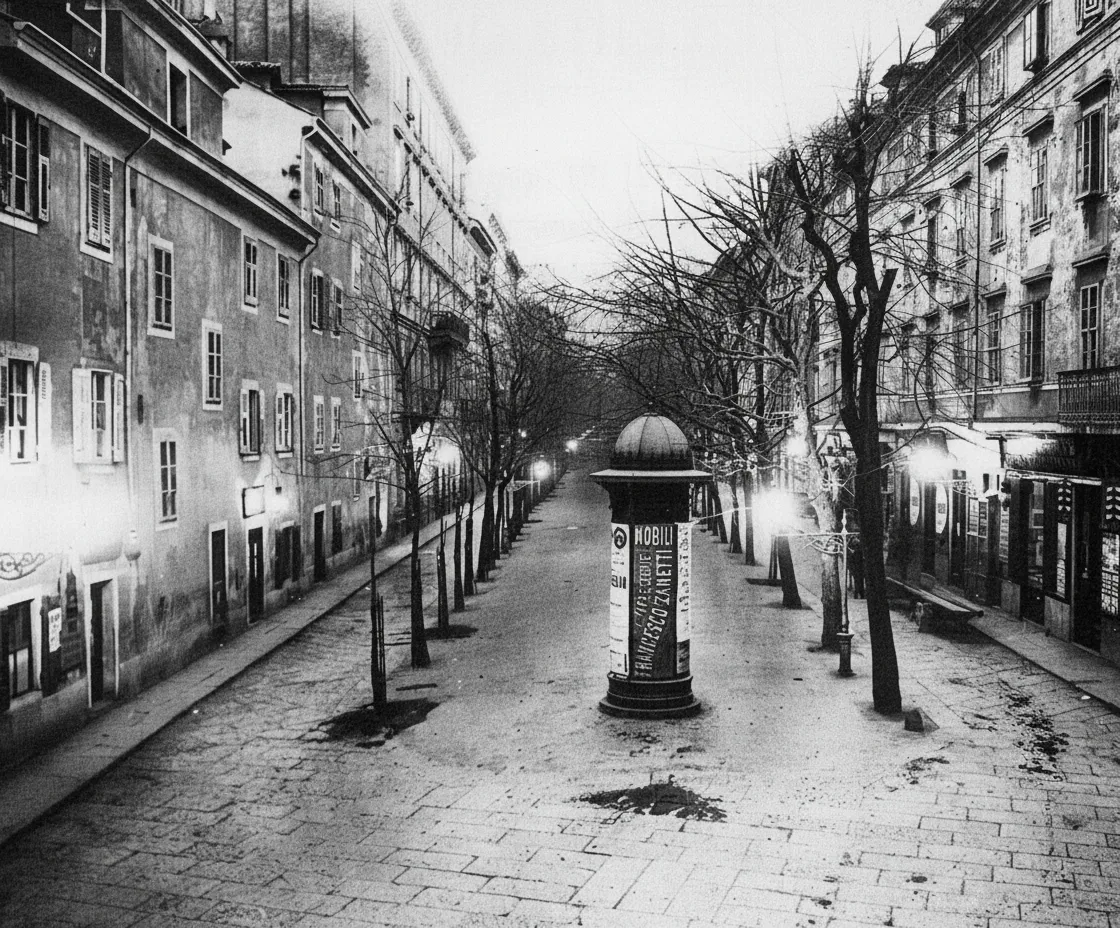
Viale XX Settembre is one of the most iconic and beloved arteries of Trieste, famous for its lively atmosphere, historic venues, cinemas and central role in the social life of the city. Its history has roots in the 19th century, when it was known as via dell’Acquedotto due to the presence of the ancient water conduits that, still today, run under its path.
From the origins to via dell’Acquedotto
The viale was born between 1807 and 1808 on the initiative of Count Domenico Rossetti, who made available to the citizens a plot of his own property, embellished with a garden and a double row of trees. The path followed the direction of the city aqueduct, which from the slopes of Monte Spaccato crossed the valley of San Giovanni and ended in the lower part of the city, in via Donota.
Initially, the area was peripheral and characterized by vegetable gardens and noble villas, but the creation of the viale marked the beginning of its urbanization and transformation into a place for strolling and social life.
The name “via dell’Acquedotto” remained in use until 1870, when, following the Breccia di Porta Pia and the Italian unification, the street was renamed Viale XX Settembre in homage to the historic date of 20 September 1870. Despite the name change, the memory of the ancient aqueduct survives to this day: the conduits run under the concrete and the viale preserves its width and its character as a tree-lined boulevard.
Place of meeting and social life
Since the 19th century, the viale became the main strolling place for the Triestine bourgeoisie, dotted with cafés, beer halls, restaurants, dance halls and theaters.
Among the historic reference points:
- Caffè Secession: an iconic venue for social encounters.
- Teatro Rossetti (today Politeama Rossetti): inaugurated in 1878, center of cultural life.
- Numerous cinemas: Excelsior, Ambasciatori and Nazionale, which have marked the cultural history of the city.
The viale is also home to the traditional fiera di San Nicolò, the most important in Trieste, which takes place every year in the week before 6 December.
Urban and architectural transformations
During the 20th century, the viale underwent numerous redevelopment interventions:
- Covering of the small stream that flowed parallel (from which the nearby via Battisti, ex Corsia Stadion was born).
- Pedestrianization of the first section.
Along the viale there are Art Nouveau style buildings:
- Casa Agnani: built in 1901.
- Palazzo Viviani Giberti (1907): seat of the Cinema Ambasciatori, designed by Giuseppe Sommaruga.
The Fontana del Giano Bifronte, with its two masks, marks the beginning of the viale and represents one of the most recognizable symbols of the area.
Curiosities and memory
At number 16 of the viale was born, on 16 December 1861, the writer Italo Svevo, who spent his childhood here and who often mentions the via in his novels.
The viale has been immortalized in period photographs depicting:
- Elegant ladies strolling.
- Markets and demonstrations.
- The lively daily life of the Triestines.
Even today, Viale XX Settembre is the beating heart of the city, a meeting place for all generations, animated by events such as “Il Viale in Fiore” and by a rich offer of shops, ice cream parlors, bars and restaurants.
Viale XX Settembre thus represents a perfect example of urban and social transformation, capable of preserving the memory of its origins and of renewing itself continuously, remaining one of the most beloved and frequented places in Trieste.