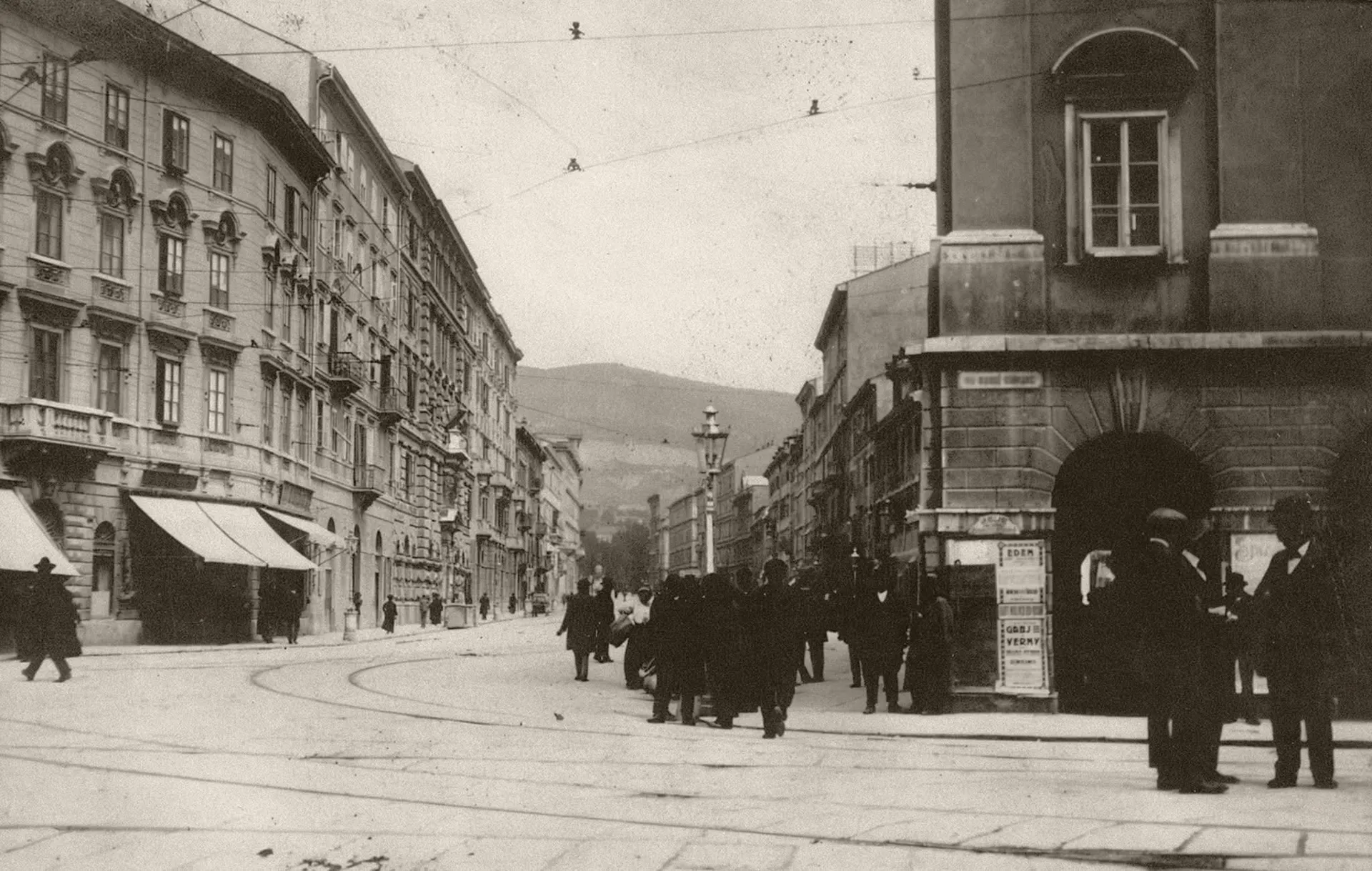
Via Cesare Battisti, in the heart of Trieste, represents one of the most significant streets from a historical, cultural, and architectural point of view, especially in the context of the Asburgo period and the early post-war period.
Historical context and urban transformations
Originally known as Corsia Stadion, the street takes its name from Count Stadion, promoter in 1846 of the filling in of the small river of the Scoglio (or Marchesetti), a stream that flowed in the open air and which, due to pollution, was covered as early as 1845.
This intervention was decisive for the prestige and redevelopment of the area, which rapidly transformed from an area of popular hovels to a neighborhood inhabited by a rich mercantile and entrepreneurial bourgeoisie on the rapid rise during the Impero Asburgico.
- The covering of the stream marked a turning point in urban and sanitary terms for Trieste.
- It favored the birth of a modern urban context.
- It saw the construction of stately palaces in eclectic and neoclassical style.
- Part of the expansion and urban decorum of a Trieste in great commercial and cultural growth in the late nineteenth century.
The Caffè San Marco and its cultural-social role in the Asburgo era and post-war period
Among the places of greatest interest in Via Cesare Battisti stands out the famous Caffè San Marco, inaugurated in 1914 at number 18 inside Casa Napp, a building designed by the architect Giorgio Polli in 1902 and owned by the Assicurazioni Generali.
The Caffè quickly became a hub of aggregation for students, intellectuals, and exponents of the Triestine irredentist youth, who gathered there for cultural and political debates.
- Notable is its role during the First World War: the venue also functioned as an operational center for the irredentists.
- It provided false passports to allow the escape to Italy of anti-Austrian patriots.
- This attracted the attention of the Austro-Hungarian authorities who in May 1915 decreed its forced closure and carried out a violent raid, marking a page of dramatic city history.
In addition to its political function, the Caffè San Marco stood out as a cultural environment, also frequented by the large Triestine Jewish community, particularly active in the field of irredentist demands and in city life. The proximity to the majestic synagogue of Via della Pace, built in 1910 and among the largest in Europe, underlines the sociocultural importance of the neighborhood.
Evolutions after the first post-war period
After the First World War and the annexation of Trieste to Italy, Via Cesare Battisti maintained its prominence as an important urban axis, although political and social changes led to modifications in the use of spaces, including always a mix between residential, commercial, and cultural.
The historical architectures remained qualifying elements of the urban fabric, reflecting the historical stratification of the city.
Overall, Via Cesare Battisti bears witness to the history of Trieste from Asburgo imperialism to the early years of post-war Italy, with its monuments, urban fabric, and the stories that intertwine in its spaces.