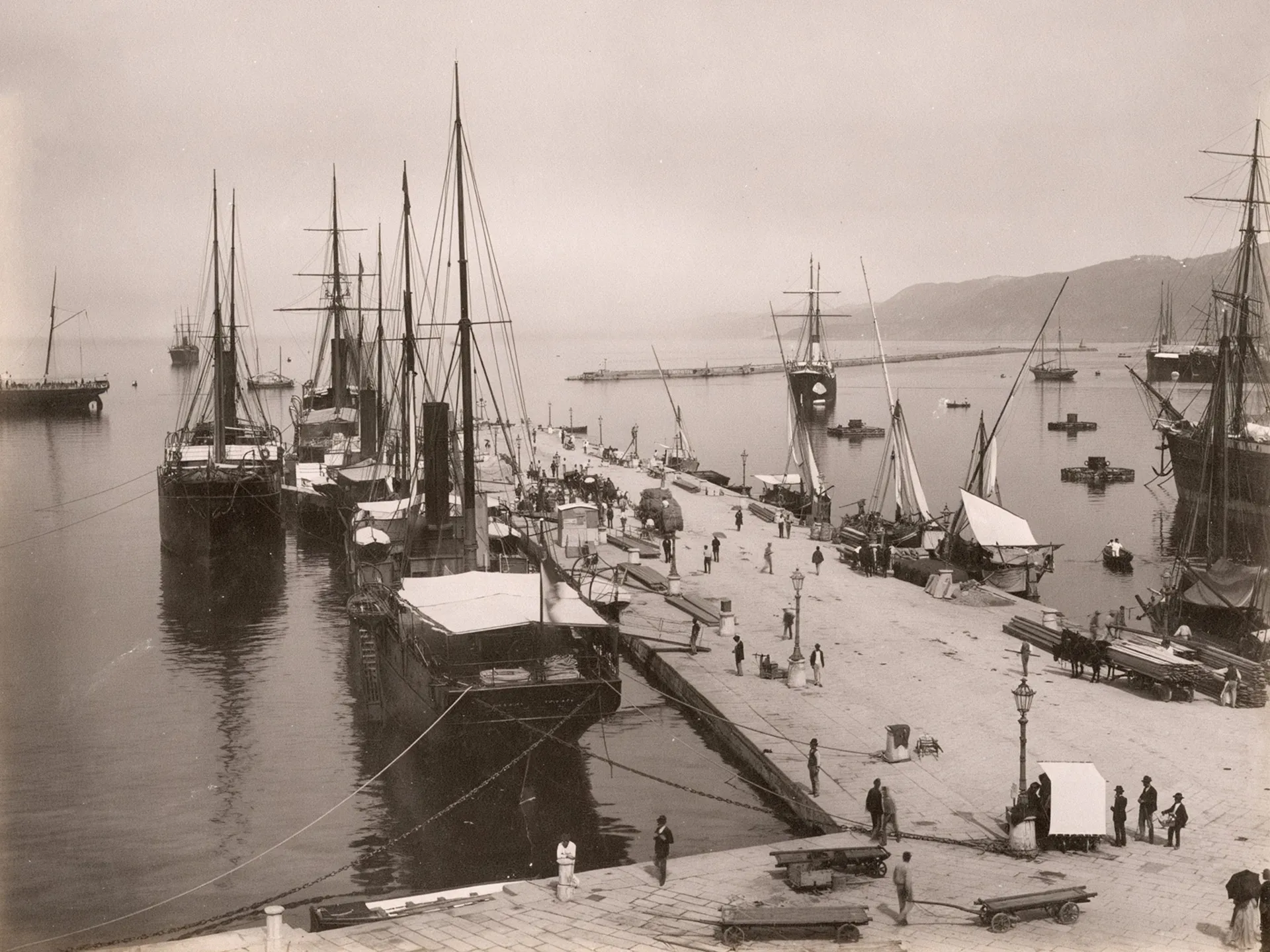
Trieste and World War I: From Imperial Port to Redemption
From the funeral of Franz Ferdinand to the arrival of the destroyer Audace, the story of Trieste between 1914 and 1918: a multiethnic city suspended between two worlds, swept up by the Great War and forever transformed.
The story of Trieste and World War I is one of the most dramatic chapters in the city's history. At the dawn of the twentieth century, Trieste was the fourth-largest urban centre of the Austro-Hungarian Empire — after Vienna, Budapest, and Prague — and the principal maritime gateway of the Habsburg monarchy. According to the 1910 census, its population reached 229,510 inhabitants: a mosaic of 118,959 Italian speakers (51.8%), 56,916 Slovenians (24.8%), 11,856 German speakers (5.2%), and smaller Serbo-Croatian and other communities.
A Cosmopolitan Hub on the Eve of Conflict
Under the long reign of Emperor Franz Joseph I, who died on 21 November 1916 during the war, Trieste had become a thriving commercial port. The Southern Railway connecting Vienna to the Adriatic, inaugurated in 1857, had transformed the city into a key node of imperial trade. With its duty-free port status, first granted in 1719 by Charles VI, Trieste attracted entrepreneurs and merchants from across Europe.
Yet beneath this prosperous surface lay growing ethnic tensions. The Austrian government, particularly after 1866, pursued a policy of distrust towards the Italian-speaking majority, promoting Slavic interests through Austro-Slavism. Prince Konrad of Hohenlohe, imperial governor from 1904 to 1915, embodied this approach, supporting the Trialism project favoured by Archduke Franz Ferdinand — the creation of a third Slavic kingdom within the Empire that would have included Trieste itself.
The Summer of 1914: From Sarajevo to the Trieste Funeral
On 28 June 1914, the assassination of Archduke Franz Ferdinand and his wife Duchess Sophie in Sarajevo sent shockwaves across the Empire. Just days later, on 2 July 1914, their bodies arrived in Trieste aboard the battleship SMS Viribus Unitis. A solemn funeral procession wound through Piazza Unità, blessed by Bishop Andrea Karlin, with Governor Prince Hohenlohe and Mayor Alfonso Valerio in attendance.
By August 1914, Trieste's young men were being mobilised into the imperial army, most dispatched to the Russian front in Galicia as part of units like the 97th Imperial and Royal Infantry Regiment, which included Slovenians, Croats, and Italian speakers from the region.
Irredentism and the Choice of Italy
Not all Triestines marched under Austrian banners. The city's Italian irredentist movement, which had grown since the martyrdom of Guglielmo Oberdan — hanged on 20 December 1882 for plotting against the Emperor — was centred in places like the Caffè San Marco, founded on 3 January 1914 by Marco Lovrinovich. Behind its elegant facade, the café hosted secret meetings and a workshop producing forged passports for patriots fleeing to Italy.
The Lega Nazionale, Trieste's largest private association with 11,569 members by 1912, served as a cultural bastion of Italian identity. On 23 May 1915 — the day Italy declared war on Austria-Hungary — pro-Austrian demonstrators set fire to its headquarters at Palazzo Tonello, along with the offices of the irredentist newspaper Il Piccolo and the Società Ginnastica Triestina.
Some 128 Triestines deserted the Austrian forces to enlist in the Royal Italian Army, among them intellectuals such as:
- Scipio Slataper, writer and literary critic
- Ruggero Timeus, journalist and political thinker
- Carlo Stuparich, writer and brother of the more famous Giani
All three fell in combat, becoming symbols of the irredentist sacrifice.
Life in Wartime Trieste
For the civilian population, the war years brought severe hardship. Port activity — the lifeblood of the city — ground to a halt. Censorship was imposed on the press and private correspondence. Food shortages worsened as supply lines from the Austrian hinterland were severed following Italy's capture of Gorizia.
Between 1915 and 1917, Italian aircraft bombed Trieste on numerous occasions, causing civilian casualties. Meanwhile, an estimated 50,000 Italian-speaking citizens of the Austrian Littoral fought in Austro-Hungarian uniform throughout the conflict, placing families on opposite sides of the war.
The Isonzo Front and the Empire's Collapse
The front line ran just thirty kilometres from Trieste — close enough that the thunder of artillery echoed through the city centre. From May 1915 to November 1917, twelve bloody battles were fought along the Isonzo river and the Karst plateau, with an estimated 500,000 dead on both sides, none achieving decisive victory.
Italy's catastrophic defeat at Caporetto in November 1917 briefly pushed the front away from Trieste. But within a year, the tide turned decisively: in October 1918, the Italian Army launched its final offensive at Vittorio Veneto, breaking through Austro-Hungarian lines. On 3 November 1918, some 300,000 Habsburg soldiers surrendered.
3 November 1918: The Audace at Molo San Carlo
That same afternoon, around 4 p.m., a flotilla of Italian destroyers emerged from the mist and entered the Austrian port of Trieste before an ecstatic crowd. The destroyer Audace was the first Italian warship to dock at the Molo San Carlo — later renamed Molo Audace in its honour in 1922.
Thousands of troops disembarked under the command of General Carlo Petitti di Roreto, designated Military Governor of Venezia Giulia and Istria. Italian Army witnesses recalled with emotion "the enveloping embrace of Trieste", noting the gaunt appearance of the crowd after years of deprivation. On 10 November, King Vittorio Emanuele III visited the city briefly, confirming the symbolic significance of the event.
In 1925, a bronze wind rose was placed at the end of the pier bearing the inscription "Fusa nel bronzo nemico III novembre MCMXXV" — cast from enemy bronze. An anchor from the Audace still stands at the base of the Faro della Vittoria, the lighthouse built in 1927 to commemorate the fallen.
The Consequences of Redemption
The formal annexation of Trieste to the Kingdom of Italy came with the Treaty of Rapallo on 12 November 1920. But the so-called redemption came at a heavy price. Trieste, once the principal port of a vast empire, became a border city with a drastically reduced hinterland.
The cosmopolitan fabric of the city began to unravel. On 13 July 1920, fascist squadristi set fire to the Hotel Balkan (Narodni Dom), the cultural heart of Trieste's Slovenian community, in an act of orchestrated violence. This marked the beginning of a systematic campaign of forced Italianisation: by the mid-1920s, Slovenian surnames and place names were changed, and in 1929 the teaching of Slovenian was banned in all public schools.
Trieste's story during the Great War remains a reminder of how conflict can irrevocably reshape a city — its economy, its identity, and the delicate bonds among its communities.