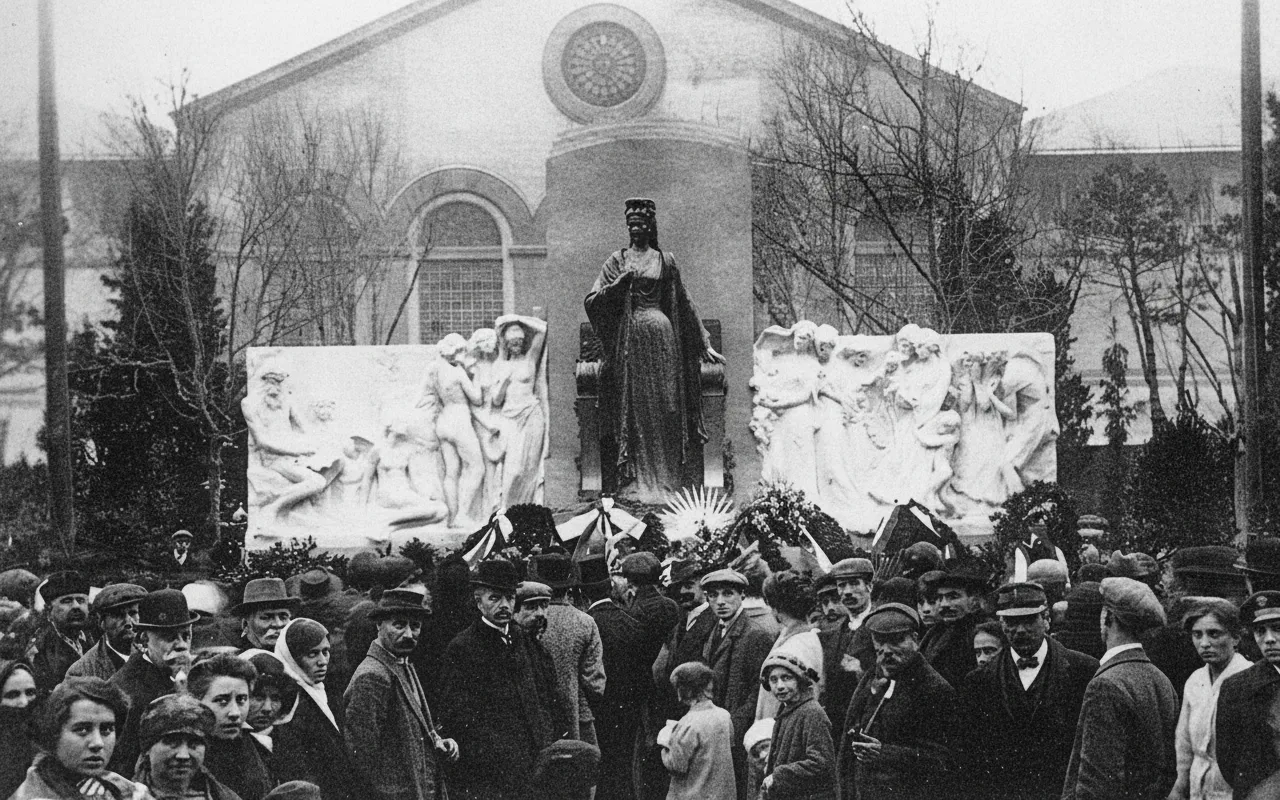
The Monument to Elisabetta d'Austria, known as "Sissi", is an important and historical symbol of the city of Trieste, erected to honor the empress recently assassinated in 1898.
History and Construction
The history of the monument begins on 1st November 1907 with an international competition announced to celebrate the sovereign.
- Great participation from Austrian, German, Italian, and French artists, who sent over 50 sketches.
- The winning project was that of the Viennese sculptor Franz Seifert.
The statue was inaugurated on 15th December 1912 in the presence of important personalities:
- The Archduke Francesco Salvatore, representative of the emperor.
- The podestà Alfonso Valerio.
Position and Description
The original monument was placed in Piazza della Stazione (today Piazza Libertà), an area also occupied by the Tripcovich theater, not far from the current position in front of the Trieste railway station.
The statue rises on a base with two steps, about 14.20 meters high:
- Pedestal formed by plinths that recall Roman ruins, symbolically survived.
- Allegorical figure of Trieste that extends towards the sovereign, uniting imperial memory with the city itself.
Removal and Relocation
In 1921, due to the political and irredentist tensions that arose after the First World War, the monument was dismantled and removed:
- Its pieces were stored for a long time in the Castello di Miramare.
It returned to its historical position only on 5th October 1997, with a heartfelt and well-attended relocation ceremony:
- Godmother the famous ballerina Carla Fracci.
- Folkloristic groups and choirs paid homage to Sissi with pieces by Mozart and popular German songs.
Materials and Significance
The monument is made of bronze and marble and is today one of the emblematic points of interest for those arriving in Trieste by train:
- Artistic and urban value.
- Strong affectionate bond that unites the city to the empress Sissi.
In recent years, the monument has suffered from degradation and neglect, also due to vandalism and lack of maintenance, but extraordinary restoration interventions have been carried out for the greenery, lighting, and cleaning.
Historical Reflections
The history of the monument thus reflects the complex political, social, and cultural events of Trieste in the twentieth century, marking the passage from the Habsburg dominion to the changing identities of the city in the following century.