Sissi in Trieste: the Empress, Miramare and the Call of the Sea
Between 1869 and 1896 Empress Elisabeth of Austria stayed in Trieste fourteen times, using Miramare Castle as her base for voyages across the Mediterranean. Discover the places, stories and monument that still commemorate her today.
When we say Sissi in Trieste, we picture the white limestone of Miramare Castle overlooking the Adriatic and the bronze monument in Piazza della Libertà — two landmarks that embody a bond stretching across nearly half a century. Between 1869 and 1896, Empress Elisabeth of Austria stayed in Trieste fourteen times, making the castle her personal gateway to the Mediterranean. Let us retrace the places, voyages and stories that tie the most restless sovereign in European history to the city she chose again and again as her harbour.
The young empress and Archduke Maximilian (1852–1857)
A meeting in Vienna and a friendship born of shared passions
When Maximilian of Habsburg settled in Trieste in February 1852, renting Villa Lazarovich in the San Vito quarter, the future Empress was still a girl in Bavaria. Their first meeting came in the spring of 1854 in Vienna, just before her wedding to Emperor Franz Joseph. The two became close friends, united by a love of poetry, art, nature and — above all — the sea.
On 24 April 1854 the imperial couple married; Trieste celebrated with the warship Kaiserin Elisabeth dressed with flags in the harbour, churches draped in red and white ribbons, and food distributed to the poor on church steps.
The first official visit to Trieste (1856)
On 19 November 1856 Franz Joseph and Elisabeth arrived in Piazza Grande to a cheering crowd, welcomed by Maximilian. Over five packed days they attended a gala performance of La Traviata at the Teatro Verdi and a ball in the Chamber of Commerce hall. Elisabeth embarked on the Kaiserin Elisabeth — freshly repainted in sky-blue and white, escorted by twelve warships — and sailed past Santa Croce to inspect the rising walls of Miramare, then on toward the Gulf of Muggia. On the return she refused the official barge and asked to be rowed back in a simple six-oar boat: an early sign of her lifelong love of freedom on the water.
Villa Lazarovich: the prelude to Miramare
While Maximilian waited for his castle to be completed, he lived in Villa Lazarovich and filled its garden with exotic plants brought from his voyages. After his marriage to Charlotte of Belgium in 1857, the Viennese court — Elisabeth included — blessed the union warmly. Villa Lazarovich thus marks the first chapter in the Habsburg story of Miramare, the chapter before the castle itself.
Trieste as a stepping-stone to the south: voyages by sea (1869–1896)
Fleeing the court — the soul of a seagull
After the death of her first daughter Archduchess Sophie in 1857 and the onset of nervous disorders, Elisabeth increasingly fled the Viennese court. The port of Trieste became her ideal launching point toward the south. "I am a seagull — I fly from wave to wave," she told her companions aboard the yacht Miramar, where she had a sheltered spot arranged on the aft deck. During storms she asked to be tied to a chair, "like Odysseus, because the waves tempt me."
The routes to Greece and Corfu
From Trieste, Elisabeth sailed regularly to Greece and the island of Corfu, where around 1890 she had the white-marble Achilleion palace built in Pompeian style by architect Raffaele Carito. These Adriatic voyages shaped her reputation as the most travelled monarch of the century and cemented Trieste's role as the imperial port of dreams.
Fourteen stays at Miramare Castle
Miramare as a strategic base
After Maximilian's execution in Mexico in 1867, Miramare Castle remained at the disposal of the imperial household with a skeleton staff. Elisabeth adored its wide windows open onto the sea and used it as a base for incognito walks through the city and excursions along the nearby coast. In the terraced park, among exotic palms and Mediterranean pines, she found the peace that the Hofburg could never offer.
Key moments at the castle
- September 1882: Elisabeth and Franz Joseph visited for the Industrial-Agricultural Exhibition at Sant'Andrea. During this stay the emperor commissioned the Eastern Telegraph Company to lay a submarine cable from Miramare to Corfu, so that he could receive news of his restless wife during her Greek stays.
- Christmas 1888: the imperial couple reunited at Miramare. It was here that Elisabeth obtained permission to buy and renovate a villa in the Gasturi district of Corfu — the future Achilleion.
- Christmas 1889: only months after the tragic death of their son Crown Prince Rudolf at Mayerling in January 1889, Elisabeth returned to Miramare in mourning dress before sailing on to supervise work on the Achilleion.
- 1891: at Miramare, Elisabeth began studying ancient and modern Greek with the young Athenian tutor Constantin Christomanos, who would later publish a diary of their time together, offering intimate glimpses of the empress's restless soul.
Sissi's places in the city
The monument in Piazza della Libertà
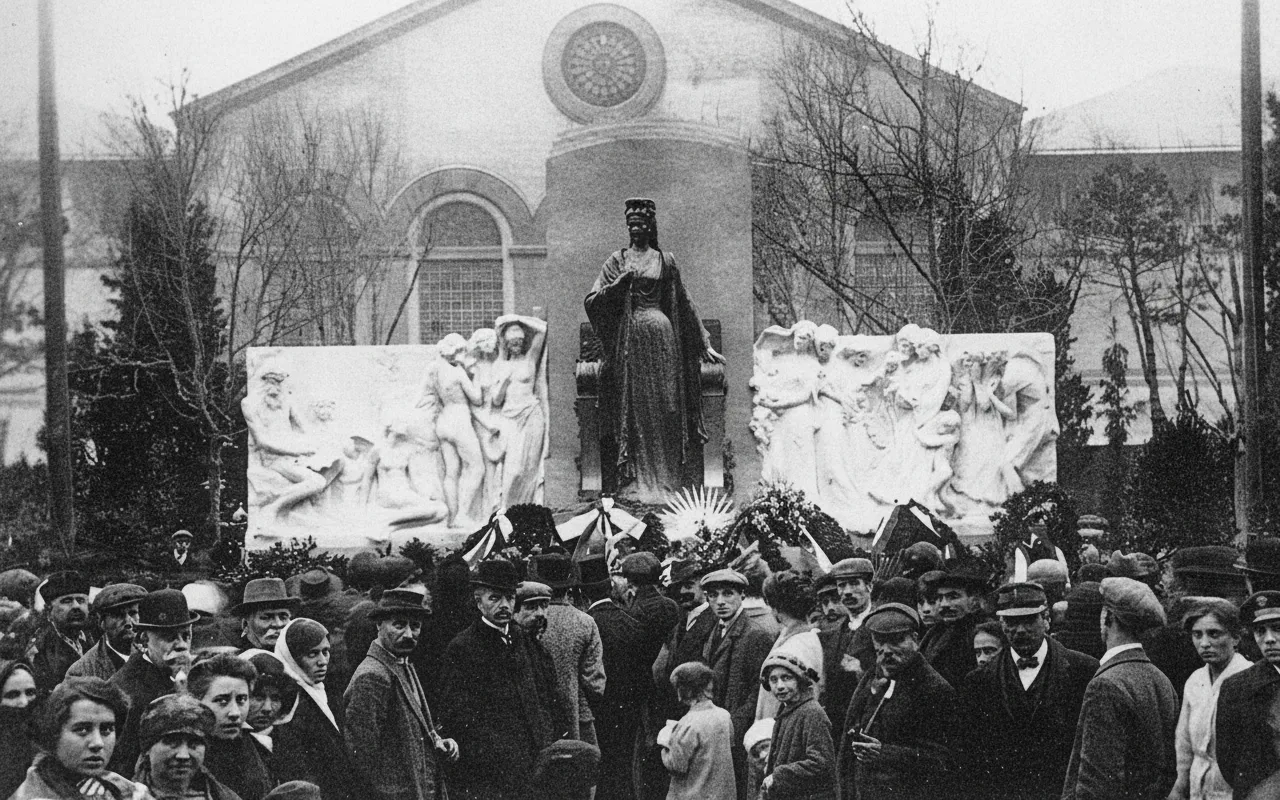
After Elisabeth's assassination in Geneva on 10 September 1898, Trieste decided to honour her memory. An international competition was announced on 1 November 1907; the winning design came from Viennese sculptor Franz Seifert. On 15 December 1912 the 14.20-metre bronze-and-marble monument was unveiled in front of the railway station in what was then Piazza della Stazione (now Piazza della Libertà), in the presence of Archduke Franz Salvator and Mayor Alfonso Valerio. An allegorical figure of Trieste reaches up toward the empress — a gesture that captures the bond between city and sovereign.
In 1921, amid post-war irredentist tensions, the monument was dismantled and stored inside Miramare Castle. It remained hidden for over seventy years until 5 October 1997, when it was restored to its original site in a ceremony with prima ballerina Carla Fracci as patron.
Historic traces between sea and city centre
Sissi's connection to Trieste extends beyond Miramare and the monument:
- The Gulf of Trieste supplied the oysters she was particularly fond of — intensively farmed here until the mid-twentieth century.
- The Sant'Andrea area hosted the 1882 exhibition she attended with Franz Joseph.
- Sailors, servants and civic leaders noted her arrivals and departures through the port across nearly three decades, weaving her name into the fabric of everyday Triestine life.
The contemporary legacy: Sisi's Road
Today, Trieste is a key stop on the Sisi Strasse — the European cultural route tracing Elisabeth's life through Bavaria, Austria, Hungary, Switzerland, Italy and Greece. The city offers visitors a compact itinerary: from the monument in Piazza della Libertà, along the coastal road to Miramare, through the castle's rooms and park, and down to the small harbour from which the empress's yachts once set sail. Few other cities along the route can claim such a concentrated cluster of authentic Sissi sites, all within a few kilometres of each other.
Trieste was never the destination for Elisabeth — it was the threshold, the last breath of familiar Habsburg ground before the open sea she loved above all else. Yet in choosing this threshold again and again, she made it her own.