James Joyce in Trieste: the Habsburg Years of the Author of Ulysses
For more than sixteen years, from 1904 to 1920, James Joyce lived in Austro-Hungarian Trieste. Discover the places, friends and works that took shape in this Central European city which gave Ulysses its form.
When we think of Joyce in Trieste, we immediately picture the bronze statue on the Ponterosso, with its inscription "…my soul is in Trieste". Behind that phrase lie sixteen years of real life, lived in a city that was then the principal port of the Austro-Hungarian Empire: an economic and cultural capital where German, Slovene, Italian, Greek and Hebrew interwove in daily life. Let us discover together how this Habsburg Trieste transformed a young, unknown English teacher into one of the greatest writers of the twentieth century, and why without his Triestine experience we probably would never have read Ulysses in the form we know.
Joyce arrives in Trieste: a Dubliner in the Habsburg Empire
1904: an unexpected landing at the crossroads of Mitteleuropa
On 20 October 1904 a twenty-two-year-old young man stepped off the train at Trieste Central Station together with his companion Nora Barnacle. He had not yet published a book, did not speak Italian and carried very little money. He hoped for a position as an English teacher at the Berlitz School, but found the local branch full: the director Almidano Artifoni proposed instead that he transfer to Pola, the main Austrian naval base on the Istrian coast, where the school had just opened a branch (Source: Museo Joyce Trieste). Joyce remained in Pola until the first days of March 1905, when he was finally able to return to the city that would become his home.
The charm of a multicultural, cosmopolitan city
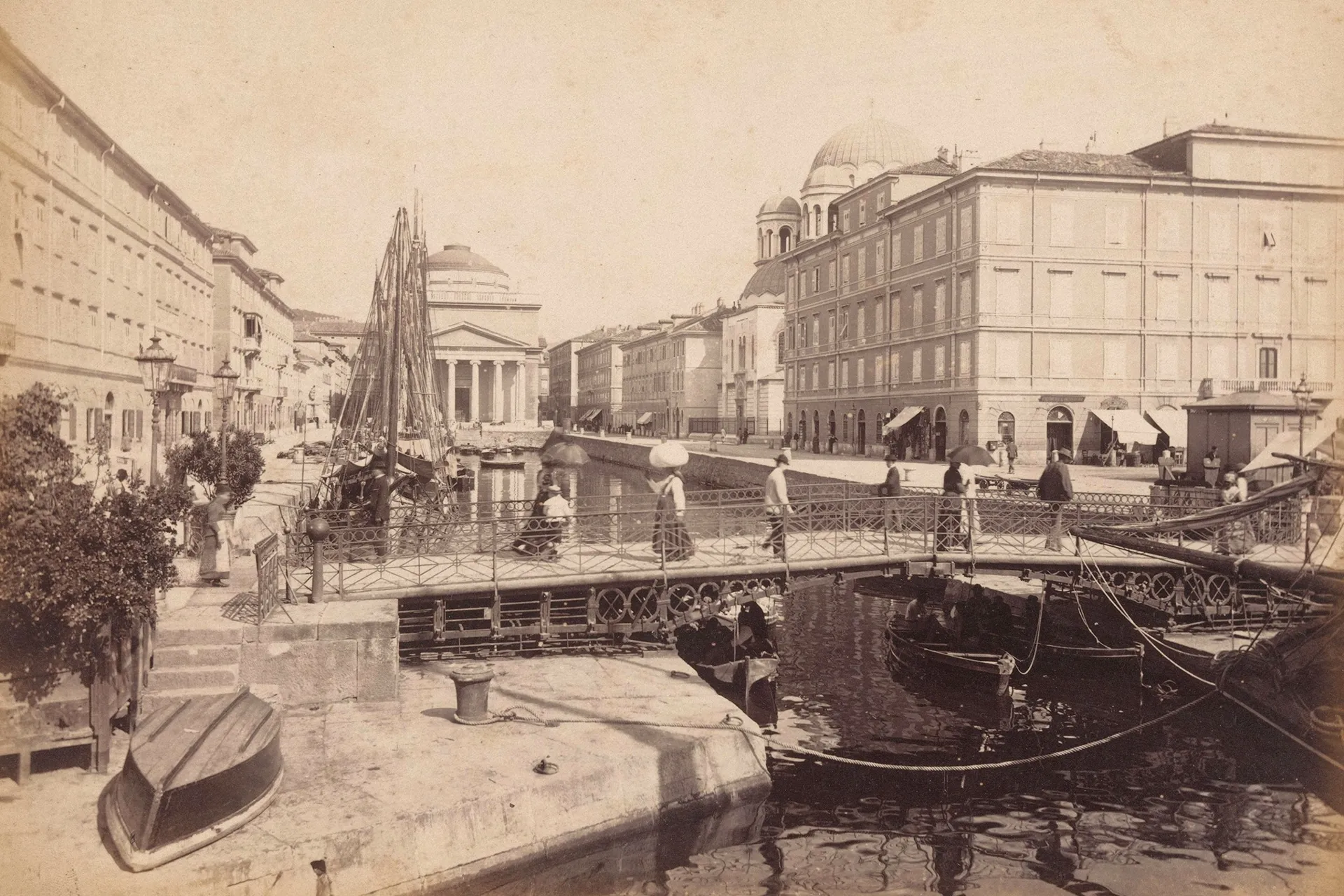
The Barriera Vecchia, the Canal Grande, Piazza Ponterosso and the streets of the Borgo Teresiano then looked like a capital in miniature: a Habsburg free port attracting a mosaic of peoples and trades:
- Greek and Armenian merchants along the Canal Grande
- Jewish bankers and industrialists tied to insurance houses
- Dalmatian sailors of the Austrian Lloyd
- German civil servants of an efficient administration
- Slovene workers from the Karst villages
For an Irishman raised in the provincial Dublin of the British Empire, Trieste represented an unprecedented mental opening. In his private notes and letters to his brothers, Joyce describes a city where the Babel of languages was not a defect but a resource: every language carried with it a point of view, a syntax of the world that he absorbed as a writer.
The Berlitz School job and Joyce's daily life in Trieste
Teaching English on Via San Nicolò: the encounter with Almidano Artifoni
The historic Trieste branch of the Berlitz School was located at Via San Nicolò 32, a few steps from the Canal Grande. Joyce taught there for several years, accumulating teaching experience that even entered Ulysses: the character of the music teacher Almidano Artifoni bears the same name as the Berlitz director who gave him his first job. The Triestine day of the writer began at the school, continued with private lessons in bourgeois homes, and often closed in the city's historic cafés, where he read newspapers in several languages and wrote on marble tabletops.
Constant economic difficulties and the lively life of the Habsburg cafés
Despite the steady work, Joyce in Trieste lived almost always at the limit of his means. Paying rent, supporting Nora and the two children — Giorgio born on 27 July 1905 and Lucia born on 26 July 1907 at the Ospedale Maggiore — meant asking for advances, moving frequently, taking private lessons at all hours. The arrival of his brother Stanislaus in October 1905, also a Berlitz teacher, only partially eased the situation. Yet it was precisely in those years that frequenting Habsburg cafés such as the Caffè degli Specchi and the Pasticceria Pirona became an integral part of his writing method: the meticulous observation of faces, dialogues and gestures animating Triestine tables provided Joyce with an endless repertoire of human types.
Two literary giants meet: the friendship with Italo Svevo
From pupil to literary confidant: lessons to Ettore Schmitz
Among Joyce's private pupils was Ettore Schmitz, an industrialist of Jewish origin in marine paints, who kept a secret dream: he had published two novels — Una vita and Senilità — received coolly by Italian critics. When Schmitz showed his books to the Irish teacher, something unexpected happened: Joyce read them, admired them and began to quote them by heart. That encouragement was decisive: twenty years later, also thanks to Joyce's intercession with French critics, Schmitz — by then known as Italo Svevo — published La coscienza di Zeno (1923), recognised as a twentieth-century masterpiece.
The influence of the Triestine bourgeoisie and Jewish community on the birth of Leopold Bloom
The friendship with Svevo was not only literary. Through him — and through the other Jewish bourgeois families where he gave lessons — Joyce absorbed a universe he would never have known in Dublin: that of Central European Jewry, made of religious tradition diluted by modernity, cosmopolitan culture, sense of humour and social marginality. This material flowed into the character of Leopold Bloom, the Jewish protagonist of Ulysses: an outsider in Dublin, but perfectly plausible for anyone who had met an Ettore Schmitz or an Aron Hector Schmitz (Svevo's birth name) in Trieste.
Joyce's places in Trieste: a walk through the city's literary map
First steps in the city: Piazza Ponterosso and the Canal Grande
Today, walking along the Canal Grande, we encounter the bronze statue created by sculptor Nino Spagnoli in 2004 for the centenary of the writer's arrival. Joyce appears walking on the bridge, hat on his head and cane in his hand, as if he had just left the Caffè San Marco. But Piazza Ponterosso also had a different face then: it was the heart of the Borgo Teresiano, an eighteenth-century quarter built by Empress Maria Theresa to welcome merchants and minority religions. Joyce crossed those streets a thousand times, recording voices, accents and scents that would resurface in Dubliners and Ulysses.
Moves and inspiration: from via Oriani to the historic house on via Bramante
The Joyce family lived at at least a dozen Triestine addresses, but three deserve special mention:
- Via della Barriera Vecchia 32 (today via Vittorio Oriani 2), from August 1910 to September 1912, in an apartment above Dr Picciola's pharmacy
- Via Bramante 4, from September 1912 to June 1915: three years which were the most productive of his Triestine arc
- Via Sanità 2 (today via Armando Diaz 2), during the brief post-war return between October 1919 and July 1920, in the apartment of his sister Eileen
It was in the via Bramante house that Joyce completed A Portrait of the Artist as a Young Man and wrote the first chapters of Ulysses.
Trieste as incubator of masterpieces: the works written in the Adriatic city
Completing Dubliners and writing the Portrait
Almost all of Joyce's early production passes through Trieste. The sequence is impressive:
- Chamber Music — poetry collection published in 1907
- Dubliners — short stories finally published in 1914 after long battle with English publishers
- A Portrait of the Artist as a Young Man — novel entirely written in Trieste, published serially from 1914
- Exiles — drama completed during the Triestine years
- Giacomo Joyce — prose poem dedicated to one of his Triestine pupils, explicitly set in the Adriatic city
In the same period Joyce also begins the novel that would change world literature.
The beginning of Ulysses: the imprint of Central European society on Joyce's epic
It is above all Ulysses that bears the indelible imprint of Joyce in Trieste. When the writer left the city in June 1915, he had already composed the first three chapters of the novel; the linguistic structure, the interior monologue, the capacity to make different registers coexist in the same paragraph derive directly from the daily experience of a multilingual city. Even the famous stream-of-consciousness technique seems to find fertile ground in Trieste: in a city where languages constantly overlapped, the mind became a polyphonic mosaic, exactly like that of Leopold and Molly Bloom.
The departure of 1920: Joyce's farewell to Trieste
The post-war return and the definitive move to Paris
With the outbreak of the First World War, in June 1915, Joyce moved his family to neutral Zurich. They would remain there four years. In October 1919 they returned to Trieste, this time settling at via Sanità 2, in the apartment of his sister Eileen. They were intense but transitional months: Joyce resumed teaching, completed the Nausicaa and Oxen of the Sun episodes of Ulysses and began Circe. In July 1920, however, he left for Paris at the invitation of Ezra Pound. He would never return to live in Trieste.
The eternal legacy: how Habsburg Trieste transformed world literature
When Joyce left Trieste, the unknown writer of 1904 had become one of the most discussed authors in Europe. Ulysses would be published in Paris in 1922 and would revolutionise world fiction, but its roots were Triestine. Years later, in a letter, Joyce would write to a friend: "…my soul is in Trieste". It was not just nostalgia: it was the lucid recognition of an intellectual debt. The Habsburg city had taught him to think in multiple languages, to read human characters as pages of an endless book, to transform the everyday into literary myth.
Sixteen years of residence, dozens of addresses, two children born, a decisive friendship with Italo Svevo, five books completed and Ulysses begun: the story of Joyce in Trieste is in the end the story of how a multicultural Central European frontier city incubated one of the most radical literary experiments of the twentieth century. Today, walking through the streets of the Borgo Teresiano or pausing before the statue on the Ponterosso, we can still catch the echo of that season: a Habsburg Trieste which, through the eyes of a Dubliner, spoke to the whole world.